Quick Facts
| Case Detail | Information |
| Discovery / Event Location | Northwest Orient Airlines Flight 305 route over southwestern Washington State. |
| Time Period / Date | November 24, 1971. |
| Famous Suspect | Unidentified man calling himself “Dan Cooper” (popularly known as D.B. Cooper). |
| Assets Extorted | $200,000 in cash ransom and four parachutes. |
| Primary Forensic Evidence | Abandoned clip-on tie, recovered currency packets, and flight instrument logs. |
| Historical Significance | The only unsolved commercial skyjacking in global aviation history. |
Introduction
The November 1971 skyjacking of Northwest Orient Airlines Flight 305 by an unidentified man calling himself “Dan Cooper” remains the ultimate unresolved anomaly in global aviation history. After extorting $200,000 in cash and four parachutes, the suspect ordered the Boeing 727 to fly toward Reno, Nevada, at a dangerously low altitude. Somewhere amid a freezing, unmitigated rainstorm over the rugged mountain forests of Washington State, the jumper lowered the aft airstairs and plunged directly into the dark wilderness below.
For over five decades, the case stood as a monumental frustration for federal law enforcement, generating thousands of dead-end leads and conflicting suspect profiles. However, when the physical artifacts are stripped of folklore and evaluated through contemporary science, a rigorous D B Cooper forensic investigation exposes an incredibly dense trail of micro-trace evidence.
What makes this mid-century skyjacking an exceptional focus for investigative review is how microscopic elements interact with the natural landscape. By shifting away from pop-culture mythology and evaluating the precise elemental signatures found on the suspect’s abandoned tie, the taphonomic breakdown of recovered ransom currency, and the unique flight dynamics of the aircraft, forensic teams have reconstructed the cold reality of the escape.
Rare Earth Elements and Electron Microscopy on the JCPenney Tie
The primary and most significant individualizing trace evidence left behind by the skyjacker was a clip-on black JCPenney tie, abandoned on seat 18e before his jump. In the early years of the inquiry, traditional fiber analysis yielded minimal results.
The definitive breakthrough occurred when the FBI allowed an independent forensic research team to analyze the tie using an advanced scanning electron microscope (SEM) coupled with energy-dispersive X-ray spectroscopy. The analysis recovered over 100,000 distinct microscopic particles embedded deep within the fabric pores.
The spectrometer exposed a highly specialized array of rare earth elements, including pure titanium, bismuth, cerium, and strontium. In 1971, these unalloyed metals were not found in standard commercial manufacturing. They were exclusive, high-security materials utilized only within cutting-edge aerospace facilities (like Boeing) or specialized chemical companies working on supersonic transport projects. This micro-trace signature strongly suggests that “Cooper” was not a transient criminal, but a highly technical industrial insider—potentially an engineer or lab contractor who wore the tie daily within a high-tech manufacturing environment.
The Taphonomic Breakdown of the Tina Bar Currency Recovery
A dramatic physical development occurred in February 1980, when an eight-year-old boy uncovered three degraded packets of the ransom money totaling $5,800 buried in the wet sand along the banks of the Columbia River at Tina Bar, north of Portland.
To determine how the money arrived at this location, forensic geologists and palynologists conducted an intensive taphonomic review of the sand layers and currency fragments. When the bills were examined under high-magnification microscopy, researchers discovered the presence of microscopic diatoms—specifically seasonal freshwater algae cells—embedded directly within the layers of the paper fibers.
The specific diatom species identified blooms exclusively during the spring months, not during the late autumn window of the November jump. This biological evidence proves that the bills did not wash onto the riverbank immediately after the skyjacking. The money had drifted or remained buried in an upstream sediment layer for months before being systematically dislodged by spring snowmelts and re-deposited downstream, establishing a clear geographic and temporal link to the regional water basins.
The 8:13 PM Flight Dynamics and Pressure Oscillation Metric
To narrow down the immense, rugged wilderness search grid, a technical analysis relies heavily on evaluating the mechanical flight dynamics and cockpit instrument recordings of the Boeing 727.
At exactly 8:13 PM, while flying through a heavy storm front at 10,000 feet, the cockpit instrumentation recorded a sudden, sharp oscillation in the cabin’s internal air pressure. Aeronautical engineers ran structural simulations using identical aircraft types to recreate this anomaly.
The testing proved that this specific pressure spike occurred only when the heavy aft airstairs, pushed down by the weight of a human body, suddenly snapped back upward as the weight was removed. This aerodynamic metric gave investigators an incredibly precise operational timestamp. By anchoring the jump to 8:13 PM and cross-referencing the plane’s exact radar tracking data, wind drift vectors, and ground speed, teams funneled the drop zone down to a tight, rugged mountain corridor near the Lewis River basin in southwest Washington.
Parachute Selection Logic and Tactical Disconnects
A critical behavioral signature evaluated by military survival experts involves the specific choices the skyjacker made regarding his escape hardware. Cooper had demanded two primary parachutes and two reserve parachutes from the authorities.
When handed the equipment, he made an irregular tactical selection. He chose an older, non-steerable military-issue NB-6 nylon canopy over a highly maneuverable sport parachute. Furthermore, for his secondary chest pack, he mistakenly utilized a non-functional training dummy reserve chute that had been cleanly sewn shut—an administrative asset that a certified skydiving professional would have recognized instantly by checking the ripcord pins.
Leaping into an un-steerable military parachute while dressed in a light business suit, overcoat, and street shoes into a 15°F (-9°C) wind-chill cloud deck at night reflects an extreme gap between theoretical knowledge and operational experience. This technical disconnect indicates that while he possessed basic military paratrooper training (potentially from the post-WWII era), he was completely disconnected from modern sport skydiving techniques, significantly reducing his statistical probability of surviving the high-velocity impact with the dense forest canopy.
The Complete Absence of Macro-Taphonomic Traces
The final phase of evaluating the Pacific Northwest search zone centers on what forensic teams call macro-taphonomic tracking. If a human individual perishes inside a dense, damp woodland environment, their remains and survival equipment enter the local taphonomic loop.
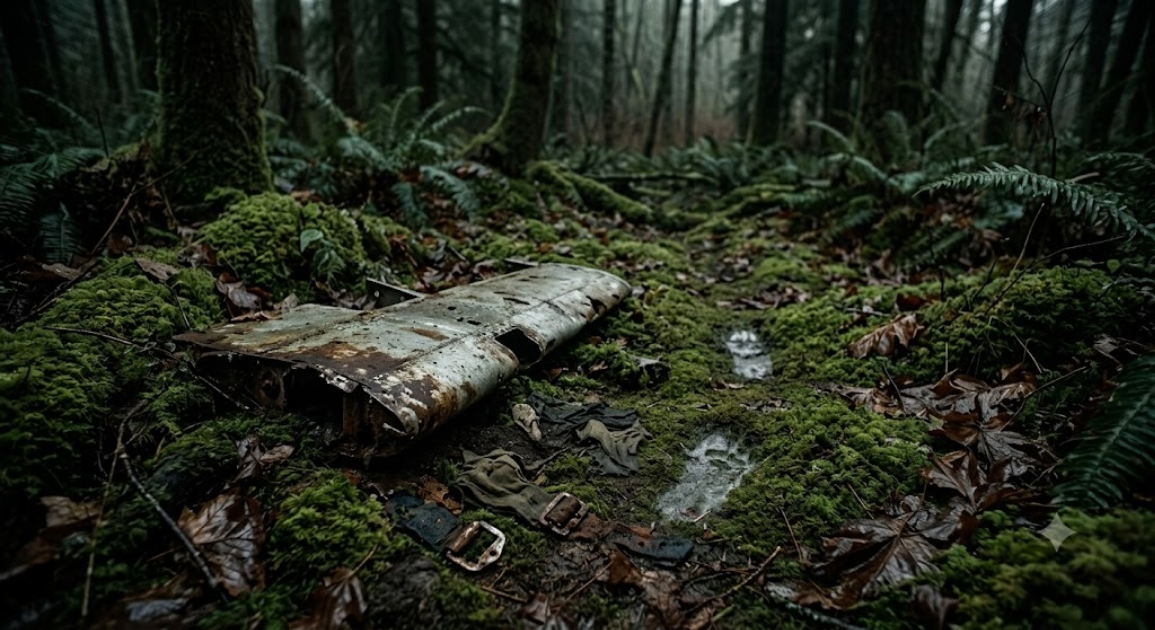
Despite intensive multi-agency ground sweeps, military maneuvers, and civilian search parties scouring the Lewis River grid for decades, absolutely zero pieces of the suspect’s main gear have ever been recovered. Nylon parachute fabric, heavy shroud lines, metal harness buckles, and the remaining $194,000 in cash are highly durable materials that do not easily degrade in acidic forest soils.
As shown in the field profiles of the region, natural forest environments can easily hide debris under deep layers of moss, ferns, and leaf litter over fifty years. The absolute lack of any localized fabric fragments or skeletal elements across the primary drop zone leaves two distinct possibilities: either the jumper survived the initial impact and successfully extracted his gear from the wilderness, or his remains lie completely sealed beneath centuries of dense moss and volcanic sediment, hidden forever from modern detection.
Fact vs. Theory
| Statement | Status | Evidence Assessment |
| The skyjacker was a low-skilled transient criminal. | Disproven | SEM analysis uncovered rare earth elements like titanium and bismuth, indicating an aerospace or chemical industry background. |
| The ransom money washed ashore immediately after the jump. | Disproven | High-magnification microscopy revealed spring diatom blooms embedded in the bill fibers, proving months of water immersion. |
| The exact timestamp of the jump is known. | Confirmed | Cockpit logs recorded a definitive cabin pressure oscillation at 8:13 PM as the aft stairs snapped back up. |
| The suspect was an expert modern sport skydiver. | Unsupported | He selected an un-steerable military canopy and mistakenly took a sewn-shut training dummy reserve parachute. |
| No traces of the main parachute or remaining cash have been found. | Confirmed | Extensive searches over five decades have yielded zero macro-taphonomic traces in the forest grid. |
Why the D B Cooper Cold Case Still Matters
The ultimate fate of D.B. Cooper remains one of the most compelling cold cases in the history of the skies. Through the precise application of electron microscopy, river sediment palynology, and aerospace flight dynamics, a comprehensive D B Cooper forensic investigation has successfully stripped away the romantic outlaw folklore to uncover a highly technical baseline profile.
The titanium signature on his tie exposes his identity as an aerospace insider, while the diatom cells on the currency anchor his money to the natural geography of the Pacific Northwest river basins. Whether he perished beneath the freezing tree canopy or walked out of the woods unnoticed, the physical clues he left behind remain permanently embedded within the landscape and fabric—a silent recording of a man who used the laws of physics to execute a flawless escape, leaving modern science to piece together his tracks.
Sources & Further Reading
-
The Federal Bureau of Investigation — The NORJAK (Northwest Hijacking) Freedom of Information Act (FOIA) Case Files
-
The Citizens NGO Forensic Team — Scanning Electron Microscopy and Energy-Disdispersive X-ray Spectroscopy Lab Reports on the Cooper Tie Artifact
-
U.S. Geological Survey & Palynology Archives — Diatom Analysis and Sediment Chronology Studies of the Tina Bar Currency Recovery Zone