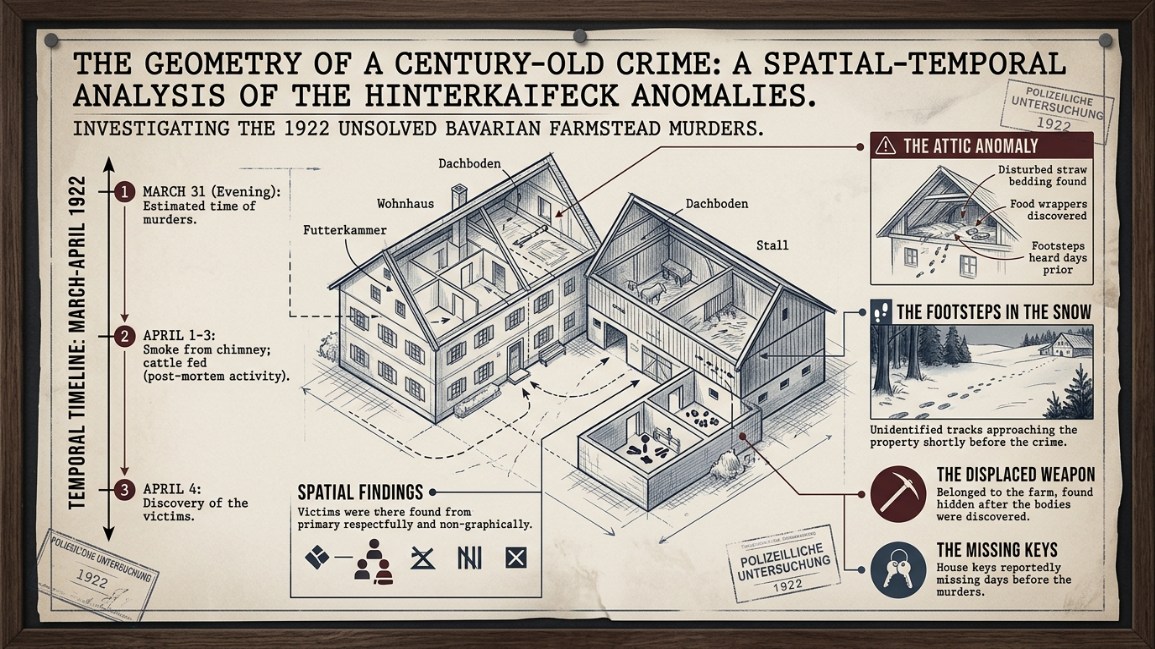
The Hinterkaifeck murders remain one of the most disturbing unsolved crimes in modern European history. On a remote farmstead in Bavaria, Germany, six people from the same household were brutally killed during the night of March 31, 1922. More than a century later, investigators and historians continue to debate who committed the murders and why.
What makes this case especially unusual is not only the brutality of the attack, but the strange events reported in the days leading up to it. Family members spoke of unexplained footprints, mysterious noises coming from the attic, and signs that someone may have been watching the property. After the murders, neighbors noticed smoke rising from the chimney and livestock being cared for—suggesting that someone remained on the farm after the killings.
While many theories have emerged over the decades, no suspect has ever been charged, and the case officially remains unsolved.
In this article, we’ll examine the known evidence, explore the leading theories, and consider what modern forensic techniques might reveal if investigators were able to revisit the case today.
Timeline of Events
Several Days Before the Murders
- Andreas Gruber discovers footprints leading from the nearby forest toward the farm.
- According to reports, there are no visible tracks leading away from the property.
- Family members report hearing unexplained noises in the attic.
- A house key reportedly goes missing.
- An unfamiliar newspaper is found on the property.
March 31, 1922
- One by one, four members of the household are lured into the barn, where they are fatally attacked.
- The family’s maid, Maria Baumgartner, and two-year-old Josef Gabriel are later killed inside the house.
April 4, 1922
- Neighbors become concerned after the family misses church services and children fail to attend school.
- A search party arrives at the farm and discovers all six victims.
Following Days
- Investigators begin examining the scene.
- Witnesses report that the animals had been fed and the fireplace had recently been used, suggesting someone remained on the property after the murders.
1923
- The Hinterkaifeck farmhouse is demolished by surviving relatives.
Why the Farm’s Layout Matters
One of the most intriguing aspects of the Hinterkaifeck case is the location itself.
Unlike a typical farmhouse situated within a village, Hinterkaifeck was an isolated farmstead surrounded by woodland. Its distance from neighboring properties meant that cries for help would have been difficult to hear, particularly at night.
The layout also connected the family’s living quarters directly to the barn and stable areas. This meant someone familiar with the property could move between buildings without stepping outside.
Some modern researchers believe this design may have worked to the killer’s advantage. If the attacker gained access to the barn unnoticed, they could remain hidden until an opportunity presented itself.
However, there is no conclusive evidence proving the killer entered the property before the murders. Any reconstruction of the attack relies on witness testimony, surviving police records, and later historical analysis rather than direct forensic evidence.
The Strange Events Before the Murders
Several incidents reported by the Gruber family in the days before the killings continue to fuel debate among historians.
Among the most frequently cited are:
- Fresh footprints leading from the forest toward the farm.
- Unexplained sounds coming from the attic.
- A missing house key.
- An unfamiliar newspaper found inside the home.
Individually, each event might have had an innocent explanation. Together, however, they have encouraged speculation that someone may have been observing the household before the attack.
Some researchers have suggested the killer could have hidden in or around the farm before the murders. Others argue that the available evidence is too limited to support that conclusion with confidence.
Because no physical evidence survives to confirm either theory, it remains impossible to determine whether these incidents were directly connected to the murders or merely unsettling coincidences.
How the Killings May Have Unfolded
Investigators believe the attack did not happen all at once.
Evidence from the crime scene suggests that four members of the family entered the barn separately, where they were killed one after another with a mattock.
Exactly how the victims were drawn into the barn remains unknown.
One theory proposes that the killer created a disturbance among the livestock, prompting family members to investigate individually. Another possibility is that the victims simply entered the barn during their normal evening routine.
Neither explanation has been proven.
What appears more certain is that the attacker maintained enough control to prevent the remaining occupants of the house from immediately realizing what had happened.
After the four adults and older child were killed in the barn, the attacker entered the house and murdered Maria Baumgartner, the family’s recently hired maid, along with two-year-old Josef Gabriel.
The use of a heavy farming tool would have allowed the attacker to inflict devastating injuries quickly, although the precise sequence of events can no longer be reconstructed with complete certainty.
What Happened After the Murders?
One of the most puzzling aspects of the Hinterkaifeck murders is what appears to have happened after the killings.
When neighbors eventually entered the property on April 4, 1922, they found evidence suggesting that someone had remained at the farm for several days after the family had been killed.
According to witness accounts and historical records, the livestock had been fed and cared for, smoke had been seen rising from the chimney, and meals appeared to have been prepared in the kitchen. These observations have led many historians to conclude that the killer did not flee immediately after the murders.
If this interpretation is correct, it raises important questions about the offender’s mindset.
Remaining at an active crime scene for days would have carried considerable risk. It suggests either an unusual level of confidence, familiarity with the isolated property, or a belief that no one would visit the farm for some time.
However, because the crime scene was heavily contaminated before investigators secured it, it is impossible to reconstruct the killer’s exact movements with certainty.
Why the Investigation Failed
The Hinterkaifeck investigation began under circumstances that would be considered deeply problematic by today’s forensic standards.
When the bodies were discovered, numerous neighbors, local residents, and officials entered the property before a systematic examination could begin. This meant footprints, fingerprints, and other forms of trace evidence were likely disturbed or destroyed before investigators documented the scene.
Forensic science in 1922 was also in its early stages.
DNA analysis did not exist.
Blood pattern analysis had not yet developed into a formal discipline.
Crime scene preservation procedures were limited compared with modern investigative practices.
As a result, investigators relied primarily on witness interviews, physical observations, and circumstantial evidence.
Although several individuals were questioned over the following years, no suspect could be linked conclusively to the murders.
Today, historians generally agree that the loss of physical evidence significantly reduced the likelihood of ever identifying the killer.
The Leading Theories
More than one hundred years later, no single theory has been proven. Several explanations continue to be discussed by historians and researchers.
1. Someone Known to the Family
One long-standing theory suggests the killer was familiar with the victims and knew the layout of the farm.
Supporters of this idea point to the apparent confidence shown during the attack and the possibility that the victims were persuaded to leave the house without immediately sensing danger.
However, no evidence conclusively identifies a friend, relative, or neighbor as the killer.
2. A Disgruntled Neighbor
Some investigators considered individuals living nearby who reportedly had disputes with members of the Gruber family.
While several names have been proposed over the decades, none could be connected to the crime through physical evidence.
Most modern historians regard these theories as plausible but unproven.
3. A Traveling Criminal
Another theory proposes that an unknown drifter or transient worker committed the murders.
Supporters argue that the isolated location would have made the farm an attractive target for someone passing through the region.
Critics of this theory question why a stranger would remain at the property after the murders rather than leave immediately.
4. The Former Husband Theory
One of the most controversial theories involved Karl Gabriel, Viktoria Gabriel’s husband, who had officially been declared dead during the First World War.
Rumors later circulated that he may have survived the war and returned secretly.
Despite years of speculation, historians have found no reliable evidence supporting this claim, and it remains one of several unverified theories associated with the case.
Could Modern Forensics Solve the Case?
If the Hinterkaifeck murders occurred today, investigators would have access to tools unavailable in 1922.
These would likely include:
- DNA analysis
- Fingerprint comparison databases
- Bloodstain pattern analysis
- Digital crime scene reconstruction
- Geographic profiling
- Advanced forensic pathology
Such techniques could potentially clarify the sequence of events, identify biological evidence left by the offender, and narrow the list of possible suspects.
Unfortunately, because the original crime scene was compromised and the farmhouse was demolished in 1923, many opportunities for modern forensic examination have been permanently lost.
This does not mean the case is impossible to study. Historical records, witness statements, and surviving investigative files continue to provide valuable insight into one of Germany’s most enduring unsolved crimes.
Editorial Analysis
The Hinterkaifeck murders continue to fascinate researchers not because they offer clear answers, but because they reveal how easily a major criminal investigation can be undermined when crucial evidence is lost.
Looking back with the benefit of modern forensic science, it is tempting to believe today’s investigators would quickly solve the case. In reality, even advanced technology depends on the quality of the evidence available. Once a crime scene has been contaminated or destroyed, many questions may remain unanswered forever.
Perhaps the most unsettling aspect of the case is not any single theory about the killer, but the possibility that ordinary warning signs—strange noises, unexplained footprints, and missing property—were dismissed because they seemed insignificant at the time.
Whether those events were directly connected to the murders may never be known. What remains certain is that the Hinterkaifeck case continues to influence discussions about crime scene preservation, offender behavior, and the importance of treating even minor anomalies seriously during criminal investigations.
Fact vs. Theory
| Statement | Status |
|---|---|
| Six people were murdered at Hinterkaifeck Farm in March 1922. | ✅ Confirmed |
| The murder weapon was a mattock or similar farming tool. | ✅ Widely Accepted |
| Someone remained on the farm after the murders. | ✅ Supported by witness observations, though exact duration is uncertain. |
| The killer lived in the attic before the murders. | ⚠️ Theory |
| The victims were lured into the barn one by one. | ⚠️ Leading reconstruction based on available evidence. |
| Karl Gabriel returned from the war and committed the murders. | ❌ Unproven theory. |
Why the Hinterkaifeck Murders Still Matter
More than a century after the murders, the Hinterkaifeck case remains one of Europe’s most studied unsolved crimes. It has inspired documentaries, books, academic discussions, and countless debates among historians and criminologists.
Beyond its mystery, the case serves as a reminder of how criminal investigations have evolved. Modern forensic science has transformed the way investigators collect and preserve evidence, yet the Hinterkaifeck murders also demonstrate that some cases may remain unsolved simply because critical opportunities were lost at the very beginning.
Until new historical evidence emerges, the identity of the killer is likely to remain one of Germany’s greatest unanswered criminal mysteries.
Sources & Further Reading
To ensure historical accuracy, readers interested in exploring the case further should consult reputable sources, including:
- Bavarian police records and historical archives (where available).
- Historical newspaper reports from the early 1920s.
- Books by recognized researchers on the Hinterkaifeck case.
- Academic publications discussing historical crime scene investigations and forensic methodology.
Article Information
- Author: Tobi
- Reviewed by: Editorial Team
- Published: June 30, 2026
- Last Updated: (Update this only when you revise the article.)
- Reading Time: 8–10 minutes