Quick Facts
| Case Detail | Information |
|---|---|
| Expedition Leader | Sir John Franklin |
| Departure Date | May 19, 1845 |
| Mission | Discover and navigate the Northwest Passage |
| Ships | HMS Erebus and HMS Terror |
| Crew Members | 129 officers and sailors |
| Last Confirmed Contact | July 1845, Baffin Bay |
| Status | Expedition lost; no survivors |
| Shipwrecks Discovered | HMS Erebus (2014), HMS Terror (2016) |
Introduction
The disappearance of Sir John Franklin’s Arctic expedition remains one of the most compelling mysteries in maritime history. In 1845, two of the Royal Navy’s most advanced ships—HMS Erebus and HMS Terror—left England on a mission to chart the final unexplored section of the Northwest Passage through the Canadian Arctic.
The expedition was expected to showcase British naval innovation and secure one of the greatest geographical achievements of the nineteenth century. Instead, all 129 crew members disappeared, leaving behind decades of unanswered questions.
For many years, historians believed the expedition failed simply because the ships became trapped in sea ice. However, discoveries made over the past four decades—including preserved human remains, archaeological excavations, and the discovery of both shipwrecks—have dramatically changed our understanding of what happened.
Modern forensic science has revealed evidence of illness, malnutrition, environmental hardship, and desperate survival strategies. While some mysteries remain unsolved, researchers can now reconstruct much of the expedition’s final months with far greater confidence than earlier generations could.
This article examines the forensic evidence behind the Franklin Expedition, separating documented discoveries from ongoing theories about one of history’s greatest Arctic tragedies.
Timeline of the Franklin Expedition
May 19, 1845
The expedition departs Greenhithe, England, with two reinforced ships carrying supplies intended to last several years.
July 1845
Whaling ships report seeing HMS Erebus and HMS Terror in Baffin Bay. This becomes the last confirmed European sighting of the expedition.
Winter 1845–1846
The crews spend their first Arctic winter at Beechey Island, where three sailors die and are buried.
September 1846
Both ships become trapped in heavy pack ice near King William Island.
June 1847
Sir John Franklin dies, leaving the expedition without its commander.
April 1848
The surviving crew abandon the ships and begin a difficult overland journey toward the Back River.
1850s
Multiple British search expeditions recover graves, equipment, and reports from Inuit communities describing starving European sailors.
2014
The wreck of HMS Erebus is discovered in the Canadian Arctic.
2016
Researchers locate HMS Terror, remarkably well preserved beneath the icy waters.
Why the Franklin Expedition Still Fascinates Researchers
The Franklin Expedition is more than a story of ships lost in the Arctic. It represents one of history’s most ambitious exploration missions ending in complete disaster despite extensive planning and advanced technology.
Unlike many historical mysteries, new evidence continues to emerge.
Archaeologists have recovered human remains, personal belongings, and well-preserved sections of both vessels. Each discovery has helped researchers answer long-standing questions while raising new ones about how the expedition unfolded.
Rather than relying solely on written accounts—which are extremely limited—modern investigators now combine archaeology, forensic anthropology, chemistry, and historical research to reconstruct events.
This multidisciplinary approach has transformed the Franklin Expedition from legend into one of the best-studied historical cold cases in the world.
The Discovery That Changed the Investigation
For decades, reports that members of the Franklin Expedition resorted to cannibalism were dismissed by many Victorian historians as unreliable or exaggerated.
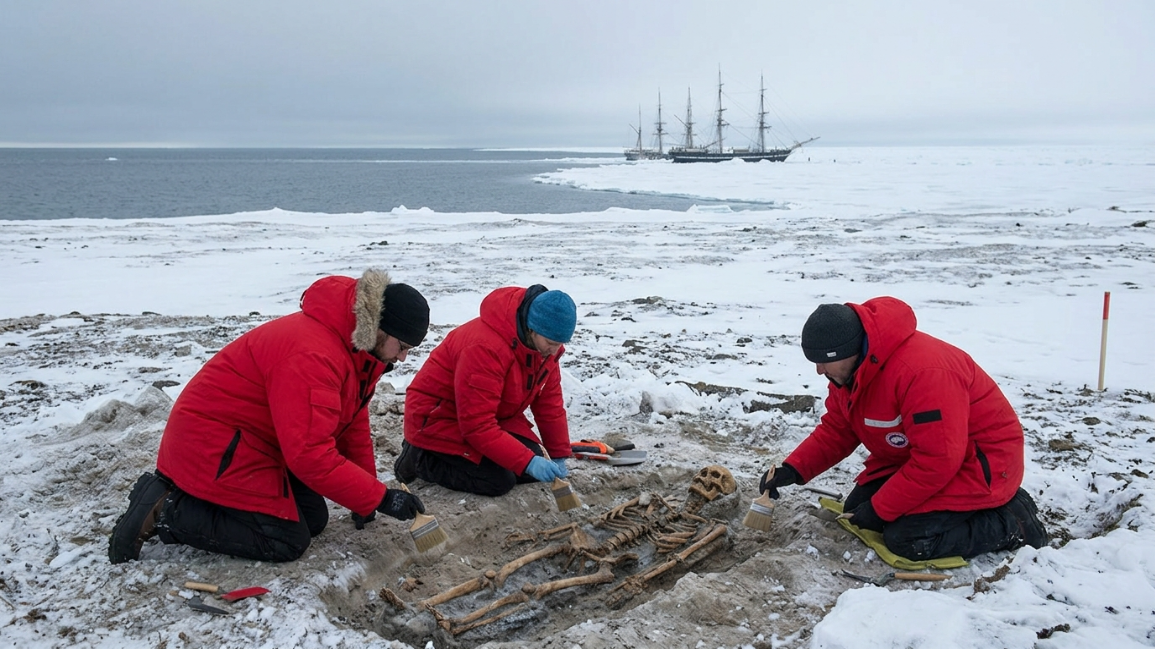
That changed when forensic anthropologists began examining skeletal remains recovered from King William Island.
Under microscopic examination, several bones displayed cut marks consistent with metal blades rather than natural weathering or animal activity. Researchers also identified fracture patterns associated with deliberate attempts to access bone marrow—a valuable source of calories during extreme starvation.
These findings supported earlier accounts provided by Inuit witnesses, who had described encountering starving sailors during the expedition’s final stages.
While these discoveries do not explain why the expedition failed, they provide compelling evidence that at least some survivors reached a point where conventional food sources had been exhausted.
The evidence also illustrates the severity of the conditions facing the remaining crew during their final months.
Lead Poisoning: Did It Contribute to the Disaster?
One of the most widely discussed aspects of the Franklin Expedition concerns lead exposure.
During the 1980s, researchers exhumed the remarkably well-preserved bodies of three sailors buried at Beechey Island. Analysis of hair, soft tissue, and bone samples revealed elevated levels of lead.
Initially, some researchers suggested that poorly soldered food tins supplied to the expedition had contaminated the crew’s provisions, gradually poisoning the sailors throughout the voyage.
This theory received widespread attention because lead poisoning can impair judgment, weaken the immune system, and contribute to fatigue—all factors that could have affected survival in the Arctic.
However, more recent research has complicated this explanation.
Studies indicate that elevated lead levels were relatively common among people living in nineteenth-century Britain due to widespread environmental exposure from plumbing, food processing, and industrial pollution. As a result, many historians now believe lead poisoning may have contributed to the crew’s declining health but was unlikely to have been the sole cause of the expedition’s collapse.
Most researchers agree that the disaster resulted from several interacting factors rather than a single fatal mistake.
What the Human Remains Reveal
The preserved bodies and skeletal remains recovered from the Franklin Expedition have provided scientists with a rare opportunity to study the health of nineteenth-century sailors.
Examinations have revealed evidence of:
- Severe physical stress.
- Prolonged malnutrition.
- Chronic illness.
- Extreme environmental exposure.
Some remains also display signs consistent with scurvy, a disease caused by vitamin C deficiency. Although the expedition carried preserved lemon juice intended to prevent the condition, historians continue to debate whether storage methods reduced its effectiveness over time.
Combined with freezing temperatures, limited fresh food, and months of isolation, these health problems would have steadily reduced the crew’s ability to travel, hunt, and survive.
Rather than pointing to a single cause of death, the forensic evidence suggests that the expedition experienced a gradual deterioration in physical health long before its final collapse.
Scurvy: The Silent Killer
Long before the Franklin Expedition reached its final stages, many crew members were likely suffering from a disease that had plagued sailors for centuries: scurvy.
Scurvy develops when the body is deprived of vitamin C for extended periods. Early symptoms include fatigue and weakness, but as the condition progresses it can cause bleeding gums, loose teeth, muscle pain, poor wound healing, and eventually internal bleeding.
Evidence recovered from skeletal remains suggests that some members of the expedition experienced changes consistent with advanced vitamin C deficiency. Researchers have identified bone abnormalities that may reflect prolonged nutritional stress, although interpreting these findings requires caution because several illnesses can produce similar skeletal changes.
The Royal Navy had attempted to prevent scurvy by supplying preserved lemon juice, a standard anti-scurvy measure of the period. However, historians continue to debate whether long-term storage, processing methods, or inconsistent distribution reduced its effectiveness during the expedition.
Whether scurvy alone proved fatal remains uncertain. Most researchers now believe it acted alongside starvation, exposure, and disease, gradually weakening the crew until survival became increasingly difficult.
What the Shipwrecks Revealed
For more than 160 years, the fate of HMS Erebus and HMS Terror remained one of the greatest unanswered questions in Arctic exploration.
That changed in 2014, when Parks Canada archaeologists located the wreck of Erebus. Two years later, Terror was discovered in remarkably good condition beneath the cold Arctic waters.
The discoveries transformed the Franklin Expedition from a historical mystery into an active archaeological investigation.
Because cold water slows biological decay, many sections of the ships have been preserved with extraordinary detail. Researchers found cabins, storage areas, equipment, and everyday objects that offer valuable insight into life aboard the expedition.
Perhaps most surprising was the condition of HMS Terror.
Rather than appearing violently destroyed, much of the vessel remained largely intact. This has led some researchers to suggest the ship was abandoned in a relatively orderly manner instead of during a sudden catastrophe.
Even so, many questions remain unanswered. Until additional areas of the wrecks are explored and their contents carefully analyzed, historians cannot fully reconstruct the expedition’s final months.
Why Did the Crew Leave the Ships?
One of the most debated questions surrounding the Franklin Expedition is why experienced naval officers abandoned two heavily supplied vessels.
A handwritten note recovered from Victory Point provides the strongest evidence available.
According to the message, the ships had been trapped in ice since September 1846. By April 1848, after nearly two years of confinement, the surviving officers decided to leave the vessels and begin an overland journey toward the Back River.
From a modern perspective, the decision appears desperate but understandable.
The crew faced a combination of:
- Prolonged ice entrapment.
- Declining food supplies.
- Illness.
- Harsh weather.
- The loss of Sir John Franklin and other crew members.
Whether remaining aboard the ships would have improved their chances remains a subject of debate. What is clear is that the overland journey proved devastating.
Archaeological evidence indicates that many sailors died along the route, leaving behind equipment, boats, and personal possessions that have since helped researchers reconstruct their final movements.
What Modern Forensics Can — and Cannot — Tell Us
Advances in forensic science have answered many questions that nineteenth-century investigators could never address.
Today, researchers can examine:
- Human remains for signs of disease and nutritional deficiency.
- Bone trauma using microscopic analysis.
- Hair samples for evidence of long-term chemical exposure.
- Shipwrecks through underwater archaeology and 3D mapping.
- Historical documents using advanced imaging techniques.
These methods have provided valuable insight into the expedition’s health, movement, and survival strategies.
However, forensic science also has limits.
Without complete written records or recoverable DNA from an unknown third party, it cannot answer every question. Historians may never know exactly how each crew member died or what happened during the expedition’s final days.
Some mysteries endure because the evidence simply no longer exists.
Editorial Analysis
The Franklin Expedition is often remembered as a story of heroic exploration ending in disaster. Modern research paints a more complex picture.
Rather than a single catastrophic event, the expedition appears to have been overwhelmed by a series of interconnected challenges. Ice trapped the ships far longer than expected. Illness reduced the crew’s physical strength. Limited access to fresh food increased nutritional deficiencies. As conditions worsened, every setback made the next one harder to overcome.
This gradual decline offers an important lesson about historical investigations.
Major disasters are not always caused by one dramatic mistake. Sometimes they result from multiple problems that, individually, seem manageable but together become impossible to overcome.
The Franklin Expedition remains one of history’s most compelling cold cases not because every mystery has been solved, but because each new archaeological discovery continues to refine our understanding of what happened in the Arctic nearly two centuries ago.
Fact vs. Theory
| Statement | Status |
|---|---|
| HMS Erebus and HMS Terror departed England in 1845 with 129 crew members. | ✅ Confirmed |
| Sir John Franklin died before the ships were abandoned. | ✅ Confirmed by the Victory Point record. |
| Crew members abandoned the ships in April 1848. | ✅ Confirmed |
| Some survivors resorted to cannibalism. | ✅ Strongly supported by forensic evidence. |
| Lead poisoning contributed to the expedition’s decline. | ⚠️ Supported by evidence, but its overall role remains debated. |
| Poorly soldered food tins alone caused the disaster. | ❌ Not supported by current historical consensus. |
| The shipwrecks will completely solve the mystery. | ⚠️ Possible, but uncertain until further research is completed. |
Why the Franklin Expedition Still Matters
Nearly two centuries after the expedition disappeared, researchers continue to study the Franklin story because it represents the intersection of exploration, survival, archaeology, and forensic science.
The discoveries of HMS Erebus and HMS Terror have shown that even long-forgotten historical mysteries can yield new evidence when investigated with modern technology.
Although some questions may never be answered, the Franklin Expedition has evolved from an unsolved disappearance into one of the best-documented examples of how archaeology and forensic science can reshape our understanding of the past.
Every new artifact recovered from the Arctic adds another piece to a puzzle that has fascinated historians, scientists, and explorers for generations.
Sources & Further Reading
For readers who wish to explore the Franklin Expedition in greater depth, consult reputable historical and scientific sources such as:
- Parks Canada archaeological reports on HMS Erebus and HMS Terror.
- Royal Geographical Society publications.
- Owen Beattie & John Geiger — Frozen in Time.
- John Geiger — Frozen in Time: Unlocking the Secrets of the Franklin Expedition (updated editions).
- Peer-reviewed forensic anthropology and Arctic archaeology journals.
- Historical records from the Admiralty and the Victory Point Record.