Quick Facts
| Case Detail | Information |
|---|---|
| Location | Roanoke Island, present-day North Carolina, USA |
| Settlement Established | 1587 |
| Governor | John White |
| Number of Colonists | Approximately 115 |
| Last Confirmed Contact | August 1587 |
| Discovery of the Empty Colony | August 1590 |
| Only Written Clue | The word “CROATOAN” carved into a wooden post |
| Status | Officially Unsolved |
Introduction
The disappearance of the Roanoke Colony has fascinated historians for more than four centuries.
Established in 1587, the English settlement on Roanoke Island was intended to become England’s first permanent colony in North America. Instead, it became one of history’s greatest unsolved mysteries.
When Governor John White returned from England in 1590, following an unexpected delay caused largely by the war with Spain, he expected to find the settlement struggling but intact. Instead, every colonist had disappeared.
There were no bodies.
No signs of battle.
No evidence of a hurried escape.
The houses had been dismantled, the fortifications remained standing, and one word—“CROATOAN”—had been carefully carved into a wooden post.
For centuries, the disappearance inspired stories of massacres, supernatural events, and mysterious disappearances. Today, however, archaeologists, climate scientists, and historians have developed a more evidence-based understanding of what may have happened.
While no single theory has been proven, modern research strongly suggests that environmental hardship, supply failures, and cooperation with Indigenous communities played a much larger role than earlier legends suggested.
Timeline of Events
1585
England establishes an earlier settlement on Roanoke Island, but it is eventually abandoned.
July 1587
John White arrives with approximately 115 colonists, including women and children.
August 1587
White returns to England to obtain supplies after the settlers request additional support.
1588
England’s conflict with the Spanish Armada delays White’s return for nearly three years.
August 1590
White finally reaches Roanoke Island and discovers the settlement abandoned.
Following Years
Search efforts fail to locate the missing colonists, and the mystery enters history.
A Colony Facing Enormous Challenges
The Roanoke settlers faced difficulties almost immediately after arriving.
Unlike later English colonies, Roanoke lacked an established agricultural system and depended heavily on supplies arriving from England. Those supplies never came on schedule.
The settlement also occupied a coastal environment unfamiliar to most of the colonists.
The sandy soils, changing weather conditions, and limited freshwater sources made farming far more difficult than many had anticipated.
Modern environmental studies suggest these challenges were even greater than earlier historians realized.
What Tree Rings Reveal About the Colony’s Final Years
One of the most significant discoveries related to the Roanoke mystery came not from archaeology but from climate science.
Researchers studying ancient bald cypress trees examined annual growth rings to reconstruct historical rainfall patterns in the region.
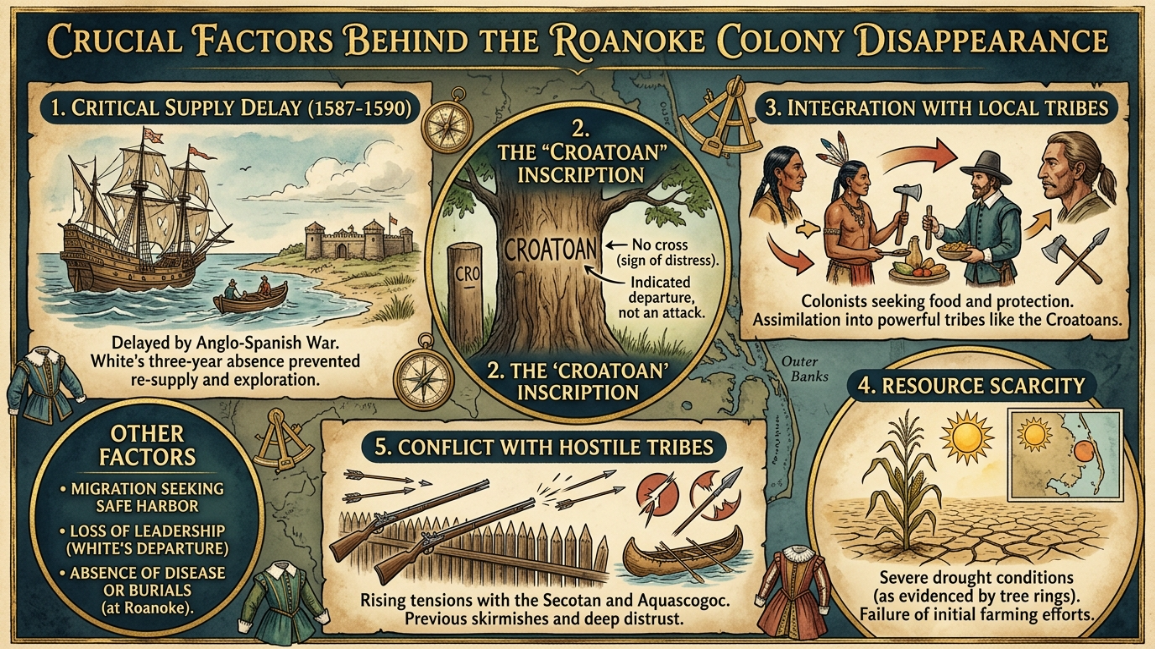
Their findings indicate that the years 1587 to 1589 coincided with one of the most severe droughts recorded in the area during the past several centuries.
For a newly established settlement dependent on farming, such conditions would have posed a serious threat.
Reduced rainfall would have affected:
- Crop production.
- Freshwater availability.
- Local wildlife.
- Relations with neighboring Indigenous communities competing for limited resources.
Although drought alone does not explain the colony’s disappearance, it likely placed enormous pressure on an already vulnerable settlement.
Could the Colonists Feed Themselves?
The geography of Roanoke Island created additional challenges.
Many English farming techniques were developed for very different landscapes, where richer soils and more predictable rainfall supported crops such as wheat and barley.
Roanoke’s coastal environment was less forgiving.
Sandy soils drain water quickly and often contain fewer nutrients than inland farmland. Combined with prolonged drought, these conditions would have made successful agriculture extremely difficult without local knowledge or alternative food sources.
Historians now believe the colonists increasingly depended on trade, fishing, hunting, and assistance from neighboring Indigenous communities to supplement their food supplies.
This possibility becomes especially important when considering the evidence suggesting that at least some colonists may eventually have joined local tribes.
The Meaning of “CROATOAN“
When John White searched the abandoned settlement, he noticed something unusual.
The word “CROATOAN” had been carved into one of the wooden posts forming the settlement’s defensive enclosure.
Importantly, White had previously agreed with the settlers that if they relocated voluntarily, they would leave a message indicating their destination.
If they departed under immediate danger, they were expected to carve a Maltese cross alongside the message.
No cross was found.
This detail has become one of the strongest arguments against the idea that the settlement was destroyed during a sudden attack.
Instead, many historians believe the carving suggests the colonists intentionally relocated—possibly to Croatoan Island, now known as Hatteras Island, where friendly Indigenous communities lived.
Exactly what happened after that relocation remains uncertain.
Archaeological Evidence Beyond Roanoke Island
One of the strongest arguments against the idea that the Roanoke colonists simply disappeared is the growing body of archaeological evidence found beyond the original settlement.
Over the past several decades, excavations on Hatteras Island—historically known as Croatoan—have uncovered a number of European artifacts dating to the late sixteenth century. These include iron tools, fragments of English ceramics, gun parts, and other objects that would have been unusual in Indigenous settlements before sustained English colonization.
Researchers caution that these discoveries do not conclusively prove the Roanoke settlers relocated there. Trade between Europeans and Indigenous communities could also explain the presence of some artifacts.
However, the concentration and dating of several finds have strengthened the theory that at least a portion of the colony may have lived among the Croatoan people after abandoning Roanoke.
Rather than pointing to a sudden disappearance, the archaeological record increasingly suggests a gradual blending of cultures.
Did the Colonists Choose to Leave?
One detail often overlooked in popular accounts is the condition of the settlement itself.
When John White arrived in 1590, he did not find burned buildings, scattered belongings, or signs of a violent struggle.
Instead, the houses had been carefully dismantled.
This distinction is important.
If the colony had been attacked without warning, historians would expect evidence of destruction or hurried abandonment. Instead, the available descriptions indicate that building materials had been intentionally taken apart and likely reused elsewhere.
Combined with the “CROATOAN” carving, many researchers believe the colonists left the settlement in an organized manner rather than fleeing in panic.
That does not necessarily mean the relocation was easy or successful—but it suggests planning rather than chaos.
Why England Never Returned in Time
The Roanoke colonists depended heavily on England for supplies, equipment, and additional settlers.
Unfortunately, events unfolding across the Atlantic dramatically changed their prospects.
In 1588, England faced the threat of invasion by the Spanish Armada. Ships that might otherwise have carried provisions to Roanoke were redirected to support the nation’s military defenses.
As a result, Governor John White’s return was delayed for nearly three years.
By the time he reached Roanoke, the colonists had already been left to survive on their own far longer than anyone had anticipated.
This prolonged isolation almost certainly forced the settlers to make difficult decisions about food, security, and survival.
What Modern Archaeology Suggests
Unlike many historical mysteries, the Roanoke Colony has benefited from advances in archaeology, environmental science, and historical research.
Today, investigators combine evidence from multiple disciplines, including:
- Archaeological excavations.
- Climate reconstruction using tree rings.
- Historical maps and documents.
- Analysis of European artifacts found in Indigenous settlements.
- Oral traditions preserved within Native American communities.
Taken together, these sources suggest that the disappearance was probably not the result of a single dramatic event.
Instead, historians increasingly view the colony’s fate as the consequence of several overlapping challenges:
- Severe drought.
- Limited food supplies.
- Delayed resupply from England.
- Dependence on neighboring Indigenous communities.
- The practical need to relocate to improve the chances of survival.
Although many details remain unknown, this explanation fits the available evidence more closely than earlier stories involving mysterious disappearances or supernatural events.
Editorial Analysis
The mystery of Roanoke endures not because there is no evidence, but because the evidence is incomplete.
For centuries, the absence of clear answers encouraged dramatic theories about massacres, curses, or unexplained disappearances. Modern archaeology paints a different picture—one rooted in environmental pressures, logistical failures, and human adaptation.
Perhaps the most significant lesson from Roanoke is that survival often required cooperation rather than isolation.
If the colonists did integrate with Indigenous communities, their story becomes less about a colony that vanished and more about a group of people who adapted to circumstances beyond their control.
While historians may never identify the fate of every individual settler, the available evidence increasingly supports the idea that the “Lost Colony” was not lost overnight. Instead, it gradually disappeared into a changing cultural and environmental landscape.
Fact vs. Theory
| Statement | Status |
|---|---|
| Approximately 115 English colonists settled on Roanoke Island in 1587. | ✅ Confirmed |
| Governor John White returned in 1590 to find the settlement abandoned. | ✅ Confirmed |
| The word “CROATOAN” was carved into a wooden post. | ✅ Confirmed |
| A severe regional drought occurred during the colony’s final years. | ✅ Supported by climate research. |
| Some colonists likely relocated to Croatoan (Hatteras Island). | ⚠️ Strong theory supported by archaeological evidence, but not conclusively proven. |
| The entire colony was massacred immediately after White left. | ❌ No conclusive evidence supports this claim. |
| The colonists disappeared through supernatural means. | ❌ No historical or archaeological evidence supports this idea. |
Why the Roanoke Mystery Still Matters
More than 430 years after the colony was abandoned, the Roanoke mystery continues to capture public imagination because it sits at the crossroads of exploration, survival, archaeology, and early American history.
Unlike many historical mysteries that rely solely on written accounts, Roanoke continues to produce new evidence through archaeological excavations and environmental research. Every artifact recovered and every historical record reexamined helps historians build a clearer picture of life—and hardship—on the edge of England’s colonial ambitions.
Although the complete story may never be known, the evidence gathered so far suggests that the colonists were not simply erased from history. Instead, they likely responded to extraordinary circumstances with the same instinct that has shaped human survival throughout history: adapting to a changing world.
Sources & Further Reading
Readers interested in exploring the Roanoke mystery further should consult:
- David Beers Quinn — The Lost Colonists: Their Fortune and Probable Fate
- Lee Miller — Roanoke: Solving the Mystery of the Lost Colony
- National Park Service — Fort Raleigh National Historic Site
- First Colony Foundation archaeological reports
- Peer-reviewed studies on dendrochronology and late sixteenth-century climate in the southeastern United States
- Contemporary writings of Governor John White