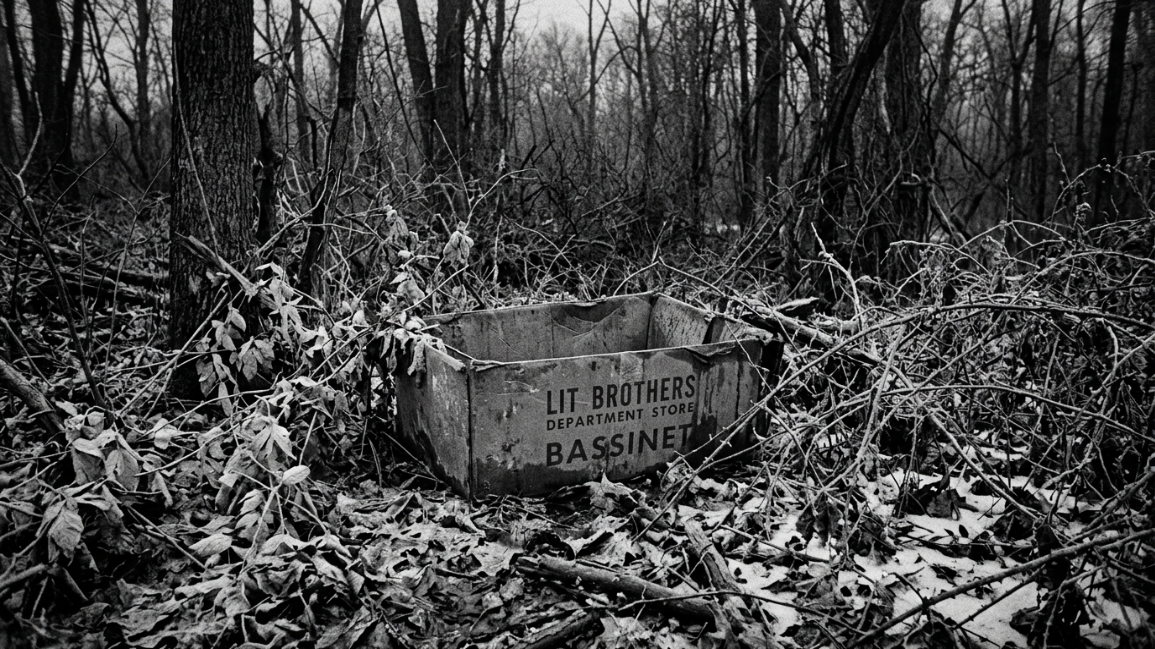
The February 1957 discovery of an unidentified young boy inside a discarded cardboard bassinet box in Philadelphia’s Fox Chase neighborhood became one of America’s most enduring cold cases. The child, estimated to be between four and six years old, was found unclothed, underweight, and bearing signs of recent grooming. Despite one of the largest homicide investigations in Philadelphia history, thousands of leads, and decades of public appeals, investigators were unable to identify him.
For more than sixty-five years, the victim was known only as the “Boy in the Box.” The breakthrough finally arrived in 2022, when advances in forensic DNA sequencing and Investigative Genetic Genealogy (IGG) allowed scientists to reconstruct his family tree. The child was officially identified as Joseph Augustus Zarelli, demonstrating how modern genetics can solve even the oldest unidentified-person cases.
What makes this investigation remarkable is not a dramatic confession or newly discovered witness, but the evolution of forensic science itself. From traditional pathology to whole-genome sequencing, every technological advance brought investigators one step closer to restoring the child’s identity.
1. Early Forensic Examination Revealed Signs of Long-Term Neglect
The first autopsy documented several unusual physical characteristics.
Investigators noted that the boy’s hair had been recently cut, with loose clippings still attached to his body. His fingernails also appeared freshly trimmed, suggesting grooming shortly before death. Pathologists additionally observed evidence of chronic malnutrition, with the child’s weight significantly below what would normally be expected for his estimated age.
Several healed scars and developmental abnormalities indicated he had experienced prolonged physical hardship before his death. Although these findings provided investigators with an extensive biological profile, they were insufficient to determine his identity because no matching missing-person report could be found.
The absence of official records led investigators to suspect that the child had lived largely outside normal social institutions, making him effectively invisible to authorities during his lifetime.
2. Traditional Identification Methods Reached Their Limits
During the 1950s, investigators relied on the best forensic tools available at the time.
Blood typing established that the victim had Type A blood, while fingerprints and footprints were compared against hospital records, adoption files, and missing children reports throughout the region. Detectives also distributed thousands of flyers and widely publicized facial reconstructions.
Despite these efforts, none of the available methods could uniquely identify the child.
Unlike DNA profiling, blood groups are shared by millions of people. Without family members to compare against or comprehensive national databases, investigators simply lacked the technology needed to individualize the victim.
The case eventually became one of the nation’s most famous unidentified-child investigations.
3. DNA Recovery Was Initially Limited by Degraded Evidence
In 1998, investigators exhumed the child’s remains in hopes that modern DNA testing might succeed where earlier methods had failed.
Recovering usable DNA from decades-old skeletal remains proved extremely challenging. Burial conditions had fragmented much of the nuclear DNA, limiting the quality of genetic material available for analysis.
Scientists were able to obtain partial genetic profiles, but the technology available at the time could not generate enough information for a successful identification.
Although the exhumation preserved valuable biological evidence for future testing, investigators would need another generation of DNA technology before meaningful progress became possible.
📊 Evolution of the Boy in the Box Investigation
| Investigative Era | Primary Technology | Main Result | Outcome |
|---|---|---|---|
| 1957 Investigation | Blood typing, fingerprints, autopsy | Physical profile established | Identity remained unknown |
| 1998 Re-examination | Early DNA extraction | Partial genetic profile recovered | Insufficient for identification |
| 2022 Investigation | Whole Genome Sequencing + Investigative Genetic Genealogy | Comprehensive SNP profile generated | Victim identified as Joseph Augustus Zarelli |
4. Whole-Genome Sequencing Changed the Investigation
The decisive breakthrough came through modern whole-genome sequencing.
Rather than relying on the short DNA markers used in traditional forensic testing, scientists generated hundreds of thousands of genetic markers known as Single Nucleotide Polymorphisms (SNPs). These markers provide a much more detailed picture of an individual’s ancestry and biological relationships.
Specialized laboratory techniques designed for highly degraded remains successfully reconstructed enough of Joseph Zarelli’s genome to create a high-quality genetic profile.
This profile became the foundation for the next stage of the investigation: genetic genealogy.
5. Investigative Genetic Genealogy Restored His Identity
Using the newly generated SNP profile, forensic genealogists searched public genealogy databases where participants had voluntarily shared their DNA for family-history research.
Rather than finding immediate relatives, investigators located several distant genetic matches. Genealogists then spent months constructing extensive family trees using census records, birth certificates, marriage licenses, and other historical documents.
By identifying where multiple family branches intersected, investigators eventually narrowed the possibilities to a single family.
Additional DNA analysis and documentary evidence ultimately confirmed the child’s identity.
On December 8, 2022, Philadelphia police publicly announced that the victim known for generations as the “Boy in the Box” was Joseph Augustus Zarelli.
Authorities have deliberately withheld many details surrounding his life and death because the homicide investigation remains active.
The Forensic Verdict
The identification of Joseph Augustus Zarelli represents one of the most significant achievements in modern cold-case investigation.
Rather than solving the mystery through eyewitness testimony or a confession, investigators relied on decades of scientific progress. Improvements in DNA recovery, whole-genome sequencing, and investigative genetic genealogy transformed biological fragments that were once considered unusable into a complete genetic identity.
Although many questions surrounding Joseph’s death remain unanswered, forensic science accomplished what generations of investigators could not: it restored the name of a child who had remained unidentified for more than sixty-five years.
His case stands as a powerful demonstration that advances in forensic genetics continue to reshape the investigation of historical cold cases, giving names back to victims long after traditional investigative methods have reached their limits.