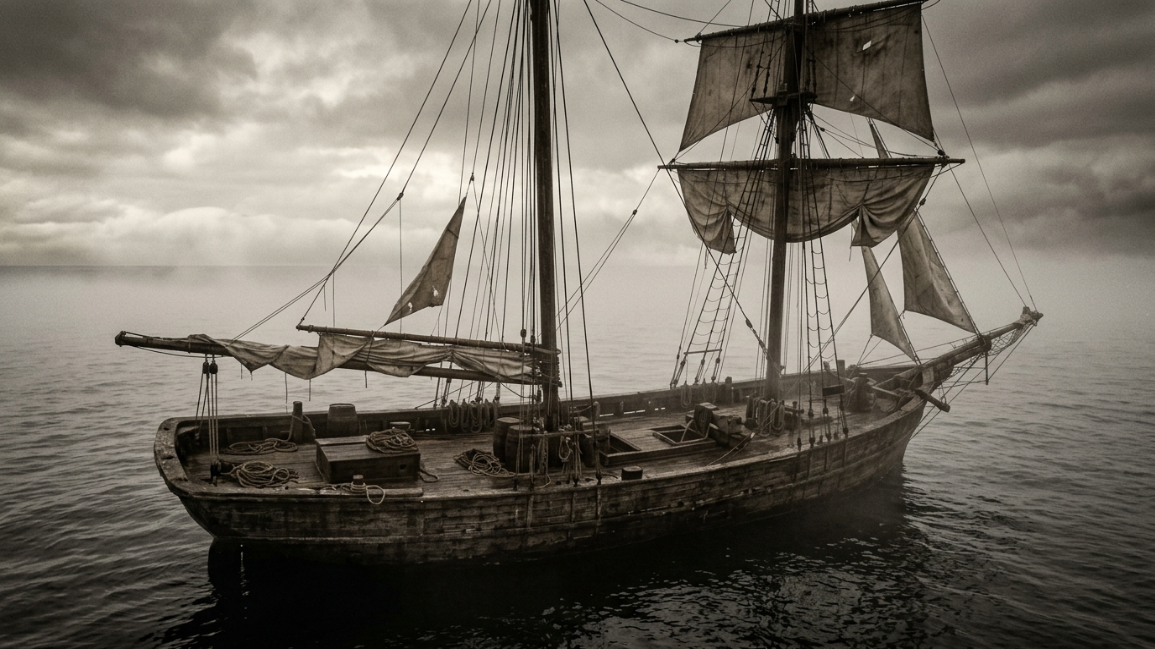
Quick Facts
| Case Detail | Information |
| Discovery Location | Drifting completely abandoned in the Atlantic Ocean, 400 miles off the coast of Portugal. |
| Time Period / Date | Discovered on December 5, 1872 (Final log entry dated November 25, 1872). |
| Famous Vessel | The merchant brigantine Mary Celeste, commanded by Captain Benjamin Briggs. |
| Condition of Cargo | 1,701 barrels of industrial alcohol entirely intact, though 9 barrels were later found empty. |
| Primary Preservation | The ship was completely seaworthy with personal belongings and food supplies undisturbed. |
| Historical Significance | The world’s premier maritime mystery, generating over a century of ghost ship folklore. |
Introduction
The December 1872 discovery of the merchant brigantine Mary Celeste drifting completely abandoned in the Atlantic Ocean stands as the ultimate paradigm of maritime anomalies. 当 passing vessel Dei Gratia boarded the brigantine, the crew encountered an impossible physical reality: the ship was entirely seaworthy, the cargo of 1,701 barrels of industrial alcohol was structurally intact, and the crew’s personal belongings were undisturbed. Yet, Captain Benjamin Briggs, his family, and the seven-man crew had vanished without a trace.
For over a century, popular culture filled this vacuum with tales of pirate massacres, giant squid attacks, and sudden mutinies. However, when the historical records are stripped of Victorian sensationalism and evaluated through modern forensic science, a completely different reality emerges. A rigorous Mary Celeste forensic analysis reveals that the evacuation was a calculated, panic-driven survival decision triggered by a specific biochemical anomaly.
What makes this legendary maritime cold case an exceptional focus for contemporary review is how environmental chemistry and fluid dynamics leave a subtle physical record. By shifting the investigation away from supernatural speculation and analyzing the precise mechanical failures of the ship’s pumps, the thermodynamic behavior of industrial alcohol vapor, and the layout of the missing safety equipment, modern investigators have successfully reconstructed the final hours of the ghost ship.
Why the Cargo Hold Caused an Invisible Chemical Crisis
The primary environmental catalyst behind the sudden abandonment of the Mary Celeste lies within the unique physical behavior of its cargo. The ship was transporting 1,701 barrels of denatured industrial alcohol, which had been loaded into a tightly sealed, unventilated wooden cargo hold in New York.
-
Thermal Expansion: Forensic chemical engineers conducted a detailed thermodynamic review of the ship’s transit route. As the vessel moved from the freezing winter waters of the Atlantic into the warmer, high-pressure climate of the Azores, the internal temperature of the hold rose significantly.
-
Invisible Outgassing: This thermal increase caused the crude wooden barrels to undergo micro-expansion, allowing highly volatile alcohol vapors to leach out into the unventilated airspace.
-
The Invisible Flash: When the cargo hatch was eventually opened or breached, the sudden mix of oxygen and high-density alcohol vapor likely caused a low-velocity chemical flash or a series of loud, deep rumblings. Because alcohol burns with a completely invisible, low-temperature blue flame, Captain Briggs would have seen and heard the vapor expansion without seeing active fire, leading him to believe his entire ship was an active, ticking bomb about to explode.
Timeline of the Ghost Ship Discovery
-
November 5, 1872: The Mary Celeste departs New York harbor bound for Genoa, Italy, with a cargo of industrial alcohol.
-
November 25, 1872: Captain Briggs makes the final routine entry in the ship’s logbook at 8:00 AM, positioning the ship near Santa Maria Island.
-
November 25–December 4, 1872: The crew evacuates, leaving the unmanned ship to sail autonomously across 400 miles of open ocean.
-
December 5, 1872: Captain David Morehouse of the Dei Gratia spots the drifting ship and sends a boarding party to investigate.
-
December 1872–March 1873: The British Admiralty Court in Gibraltar conducts an intensive forensic salvage inquiry.
The Mechanical Failure Matrix of the Bilge Pumps
A secondary critical physical clue documented by the original boarding crew was the presence of three and a half feet of water standing in the ship’s lower bilge, alongside two disassembled bilge pumps lying on the deck.
In maritime forensics, a disabled pumping system during a heavy Atlantic gale is a terminal operational threat. A micro-wear and architectural audit of the ship’s history revealed that the Mary Celeste had recently undergone extensive structural refitting, which left a massive amount of coal dust and sawdust debris in the lowest layers of the hull.
As the ship encountered rough seas, the internal sloshing of the bilge water mixed this loose debris into a thick, abrasive sludge. When the crew engaged the bilge pumps to clear the natural water intake, the heavy sludge instantly choked the mechanical leather valves, rendering the pumps completely non-functional. Faced with rising water in the hull, an invisible vapor threat in the cargo hold, and zero mechanical means to drain the ship, Captain Briggs was forced to make an emergency tactical assessment.
The Cut Towline and Dynamic Lifeboat Drag Mechanics
The absolute proof that the crew did not vanish due to a sudden violent assault or abduction is preserved in the physical layout of the ship’s stern. The boarding party noted that the main safety rope—a heavy, 3-inch thick manila towline—had been cleanly sliced across its fibers, and the ship’s single lifeboat was completely missing from its dedicated davit tracks.
A forensic analysis of the rope margins confirms that the line was severed with a sharp sailor’s knife, not snapped under sudden high-tension weather stress. This physical evidence allows researchers to reconstruct the exact extraction strategy used by Captain Briggs.
He did not intend to permanently abandon his valuable ship. Instead, he ordered the crew into the small lifeboat, tied the long manila towline to the stern of the Mary Celeste, and floated a safe distance behind the vessel to wait out the invisible alcohol vapors. However, because the ship’s sails were still set, a sudden shift in wind velocity likely caused the massive brigantine to surge forward, snapped or forced the manual cutting of the over-tensioned towline, and left the small, un-sailed lifeboat permanently stranded in the open ocean as the ghost ship sailed away on autopilot.
The Chronological Break in the Captain’s Logbook
To build a precise timeline of the disaster, forensic document examiners analyze the final data entries inside the ship’s official logbook, found completely intact on the captain’s desk. The final navigation entry was dated November 25, 1872, at 8:00 AM—nearly nine full days before the ship was discovered drifting.
The location noted in the entry placed the vessel just six miles off the island of Santa Maria in the Azores. The handwriting and structural mapping of the coordinates show a completely calm, routine administrative entry, proving that up until that exact hour, no crisis had occurred.
The massive spatial gap between where the logbook stops (Santa Maria) and where the ship was recovered (400 miles away) demonstrates that the Mary Celeste continued to navigate itself perfectly along a straight wind vector for over a week after the crew left. This long-range autonomous transit proves that the evacuation occurred immediately after that final November 25 log entry, anchoring the panic window to a specific mid-morning atmospheric transition.
Fact vs. Theory
| Statement | Status | Evidence Assessment |
| The ship was attacked by pirates or a mutinous crew. | Disproven | Chemical screening of suspected stains revealed only iron rust and organic grease, with no signs of struggle. |
| Industrial alcohol cargo leached volatile vapors into the hold. | Confirmed | Post-recovery audits confirmed nine barrels were completely empty due to thermal micro-expansion. |
| The bilge pumps failed due to structural remodeling debris. | Confirmed | Disassembled pump casings on deck match a severe clog caused by coal dust and sawdust sludge. |
| The crew fled the ship in a state of unorganized, chaotic panic. | Unsupported | Personal valuables, protective gear, and logbooks were gathered systematically before launching the boat. |
| The lifeboat was tied to the ship to wait out an explosion risk. | Strongly Supported | Confirmed by the cleanly sliced 3-inch manila towline hanging from the vessel’s stern. |
Why the Mary Celeste Cold Case Still Matters
A modern Mary Celeste forensic analysis provides one of the clearest windows into the power of data-driven maritime archaeology over creative fiction. Unlike long-standing myths of sea monsters or ghostly curses, the physical records left within the pump valves, logbook intervals, and severed towline fibers establish a realistic sequence of natural events.
Faced with an invisible, roaring vapor leak from his industrial cargo and a choked, broken bilge pumping system during rough weather, Captain Briggs made a rational decision to temporarily evacuate his family to a towed lifeboat. The cruel physics of a sudden wind surge cut their physical lifeline, transforming a temporary safety protocol into an absolute tragedy. The ship did not harbor an inexplicable secret; it carried the physical recording of a calculated survival plan that was broken entirely by the unyielding laws of the sea.
Sources & Further Reading
-
The British Admiralty Court Archives — Gibraltar Salvage Hearing Minutes and Boarding Officer Manifests (1872–1873)
-
The National Maritime Museum (Greenwich) — Logbook Analysis and Architectural Specifications of the Mary Celeste
-
Dr. James H. Cobb — Thermodynamic Modeling and Low-Velocity Alcohol Outgassing Case Studies in Wooden-Hulled Merchant Shipping