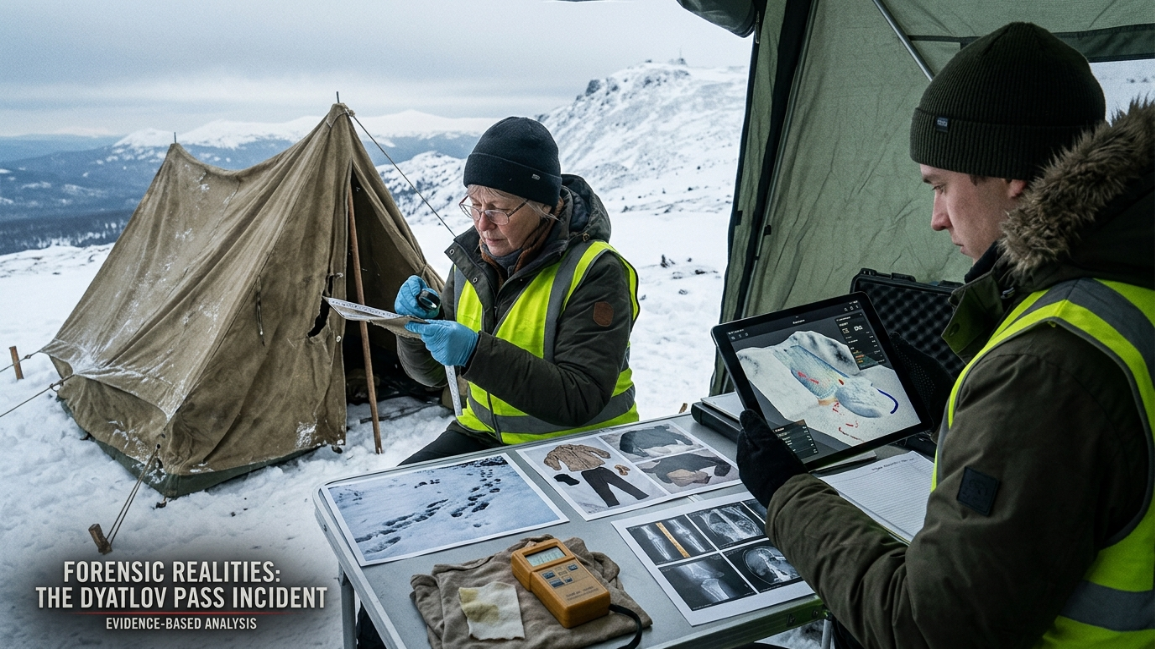
Quick Facts
| Case Detail | Information |
|---|---|
| Location | Kholat Syakhl, northern Ural Mountains, Soviet Union (now Russia) |
| Date | February 1959 |
| Expedition Leader | Igor Dyatlov |
| Expedition Members | Nine experienced hikers |
| Bodies Recovered | February–May 1959 |
| Official Cause (2021 review) | Avalanche-related event followed by hypothermia |
| Status | Cause largely explained, though some details remain debated |
Introduction
Few twentieth-century mysteries have inspired as much speculation as the Dyatlov Pass Incident.
In February 1959, nine experienced hikers died during a winter expedition in the northern Ural Mountains.
When rescuers reached the campsite weeks later, they discovered a baffling scene.
The tent had been cut open from the inside.
Most of the hikers had fled into freezing conditions without adequate clothing.
Some bodies were found near a cedar tree, while others lay farther away along the route back toward the campsite.
The final four victims, recovered months later beneath deep snow in a ravine, displayed severe internal injuries that fueled decades of speculation.
For years, explanations ranged from secret military experiments to unidentified creatures and paranormal events.
Modern forensic science, computer modeling, and a renewed official investigation have shifted attention toward environmental hazards, avalanche dynamics, and the physiological effects of extreme cold.
Although historians and scientists continue to debate some details, the evidence today paints a far more coherent picture than the sensational theories that once dominated public discussion.
Timeline of Events
January 23, 1959
The expedition leaves Sverdlovsk by train.
January 27
The group begins its ski expedition into the northern Urals.
February 1
The hikers establish camp on the eastern slope of Kholat Syakhl.
Night of February 1–2
An emergency forces the group to leave the tent.
February 26
Search teams locate the abandoned campsite.
February–May
The bodies of all nine hikers are recovered in stages.
2020–2021
A renewed investigation concludes that an avalanche-related event followed by hypothermia is the most likely explanation.
The Mystery at the Campsite
The campsite immediately puzzled investigators.
The tent had been cut open from the inside rather than through its entrance.
Most clothing, boots, food, and equipment remained inside.
Footprints leading away from the tent suggested that several hikers had walked downhill instead of running in panic.
The tracks eventually disappeared beneath fresh snowfall.
These observations raised an obvious question.
Why would experienced mountaineers leave shelter during one of the coldest nights of the expedition?
Modern researchers generally agree that the hikers believed remaining inside the tent posed a greater immediate danger than venturing into the freezing darkness.
Exactly what created that danger has been the focus of decades of investigation.
The Avalanche Debate
For many years, critics argued that an avalanche could not explain the tragedy.
The campsite appeared to be located on a relatively modest slope, and early rescue teams reported little evidence of a large avalanche.
As a result, alternative theories gained popularity.
More recently, however, researchers have proposed that the group may have been affected not by a massive avalanche but by a small slab avalanche.
According to this hypothesis, the hikers cut into the snowpack while preparing their campsite.
Combined with wind-driven snow accumulating during the night, this may have destabilized the slope above them.
Computer simulations published in recent years have shown that even a relatively small slab of dense snow could have struck the tent with enough force to make the hikers believe they were in immediate danger.
This explanation formed a key part of the conclusions reached during Russia’s renewed investigation in 2021.
Although not every researcher agrees, it is now one of the leading scientific explanations for why the group abandoned the tent so quickly.
The Effects of Extreme Cold
Once outside the tent, the hikers faced conditions that rapidly became life-threatening.
Temperatures were well below freezing, and strong winds greatly increased the rate at which body heat would have been lost.
Without insulated clothing or proper footwear, survival time became extremely limited.
Evidence suggests that the group attempted to remain together after leaving the campsite.
Some members reached a large cedar tree, where investigators later found signs of a small fire.
Others appear to have attempted to return to the tent, perhaps realizing that their only realistic chance of survival lay in recovering the equipment they had left behind.
Unfortunately, the weather and darkness made that journey increasingly difficult.
The Unusual Injuries
The most controversial aspect of the case involves the injuries suffered by four hikers whose bodies were discovered months later in a snow-filled ravine.
They sustained severe chest and skull injuries that appeared disproportionate to the visible damage on their skin.
At first, these findings encouraged speculation about explosions, assaults, or military weapons.
Modern biomechanical research offers a different perspective.
Scientists have noted that compression beneath large masses of snow can produce serious internal injuries while leaving relatively limited external trauma.
Although the exact mechanism remains debated, researchers generally agree that these injuries are consistent with powerful natural forces rather than deliberate violence.
Hypothermia and Human Survival
Extreme cold affects both the body and the mind, often leading to decisions that seem irrational to those observing them afterward.
Medical research shows that as body temperature falls, judgment becomes impaired, coordination deteriorates, and simple tasks become increasingly difficult. Victims may struggle to think clearly or recognize the seriousness of their condition.
Evidence from the Dyatlov campsite suggests that the hikers attempted to survive after leaving the tent.
Near a large cedar tree, investigators found the remains of a small fire and broken branches several meters above the ground, indicating that at least one member of the group climbed the tree, possibly to look for the tent or to gather firewood.
Some hikers later attempted to return uphill toward their shelter but collapsed before reaching it.
These actions reflect organized attempts at survival rather than panic or confusion alone.
The Missing Tongue and Soft Tissue
Perhaps no detail has fueled more speculation than the discovery that one victim, Lyudmila Dubinina, was missing her tongue and portions of facial soft tissue.
At first glance, this appeared deeply suspicious.
Modern forensic pathology, however, offers a far less mysterious explanation.
Dubinina and three other hikers were recovered months after the incident beneath deep snow in a ravine through which meltwater flowed during the spring thaw.
Soft tissues such as the tongue, lips, eyes, and cheeks are among the first parts of the body to decompose after death. Flowing water, freeze-thaw cycles, and scavenging by small animals can accelerate this natural process.
Forensic specialists therefore consider these injuries to be consistent with post-mortem decomposition rather than evidence of violence.
Although the appearance of the bodies was disturbing, it does not indicate that the injuries occurred while the victims were alive.
What About the Radiation?
Another frequently repeated claim is that investigators found radioactive contamination on some of the hikers’ clothing.
This statement is true—but it is often presented without context.
Tests performed during the investigation detected elevated levels of radioactivity on a small number of garments.
However, the readings were relatively limited and have several possible explanations.
Some members of the expedition had previously worked in environments where low-level radioactive contamination was present, making incidental transfer onto clothing possible.
Researchers have also noted that naturally occurring radioactive materials can sometimes produce elevated readings under certain conditions.
To date, no credible evidence links the detected radiation to secret weapons testing or a military experiment.
Most historians consider this aspect of the case interesting but insufficient to support conspiracy theories.
The 2020–2021 Investigation
More than sixty years after the tragedy, Russian authorities reopened the case using modern forensic methods.
Investigators reviewed historical documents, conducted field experiments, examined weather records, and commissioned computer simulations of snow movement on the slope.
The final report concluded that the most likely sequence of events involved a slab avalanche or similar snow movement that damaged the tent and prompted the hikers to evacuate quickly.
Once outside, they descended the slope in poor visibility without adequate winter clothing.
Several members later died from hypothermia, while the severe injuries sustained by the final four victims were attributed to compressive forces associated with snow collapse in the ravine.
Although not every researcher agrees with every aspect of the report, it represents the most comprehensive official investigation conducted since 1959.
Evidence Assessment
The Dyatlov Pass Incident remains one of the most carefully studied historical mysteries of the twentieth century.
Unlike many famous cases, investigators recovered substantial physical evidence, including the campsite, equipment, clothing, footprints, weather data, and the bodies themselves.
Modern research suggests that the tragedy resulted from a cascade of environmental hazards rather than a single dramatic event.
A snow-related emergency appears to have forced the hikers from their tent. Exposure to extreme cold then became the primary threat, while several members suffered severe injuries after ending up in the snow-filled ravine.
Some details of the incident—including the exact sequence of decisions made during the final hours—may never be known with certainty.
However, the available evidence strongly favors natural causes over theories involving attacks, secret weapons, or paranormal phenomena.
Fact vs. Theory
| Statement | Status |
|---|---|
| Nine hikers died during the 1959 Dyatlov Pass expedition. | ✅ Confirmed |
| The tent was cut open from the inside. | ✅ Confirmed |
| Most clothing and equipment remained inside the tent. | ✅ Confirmed |
| Several hikers died from hypothermia. | ✅ Confirmed |
| A slab avalanche or similar snow event triggered the evacuation. | ⚠️ Leading scientific explanation and supported by the 2021 official investigation, though some researchers continue to debate details. |
| Severe injuries to four hikers were caused by compressive snow forces in the ravine. | ⚠️ Strong scientific explanation, but the exact mechanism cannot be proven with complete certainty. |
| Infrasound caused the hikers to flee. | ⚠️ Proposed hypothesis with limited supporting evidence; not part of the official conclusion. |
| Secret military weapons, UFOs, or cryptids caused the incident. | ❌ No credible evidence supports these claims. |
Why the Dyatlov Pass Incident Still Matters
More than six decades after the tragedy, the Dyatlov Pass Incident continues to attract worldwide attention because it combines unusual forensic evidence with one of the harshest natural environments on Earth.
Advances in avalanche science, biomechanics, and forensic pathology have helped explain many aspects of the case that once seemed impossible. At the same time, the incident demonstrates how quickly multiple environmental hazards can combine into a deadly chain of events.
The story also highlights an important lesson for historians: extraordinary claims often emerge when evidence is incomplete. As new scientific methods become available, long-standing mysteries can be reevaluated without relying on speculation or sensationalism.
Although some questions about the hikers’ final movements may never be answered, the Dyatlov Pass Incident stands as a powerful example of how careful analysis can bring us closer to understanding even the most puzzling events in history.
Sources & Further Reading
Readers interested in exploring the Dyatlov Pass Incident further should consult:
- Russian Prosecutor General’s Office findings (2020–2021 reinvestigation)
- Johan Gaume & Alexander Puzrin — research on the slab avalanche hypothesis (Communications Earth & Environment, 2021)
- Donnie Eichar — Dead Mountain: The Untold True Story of the Dyatlov Pass Incident
- Keith McCloskey — Mountain of the Dead
- Peer-reviewed studies on hypothermia, avalanche dynamics, and forensic pathology