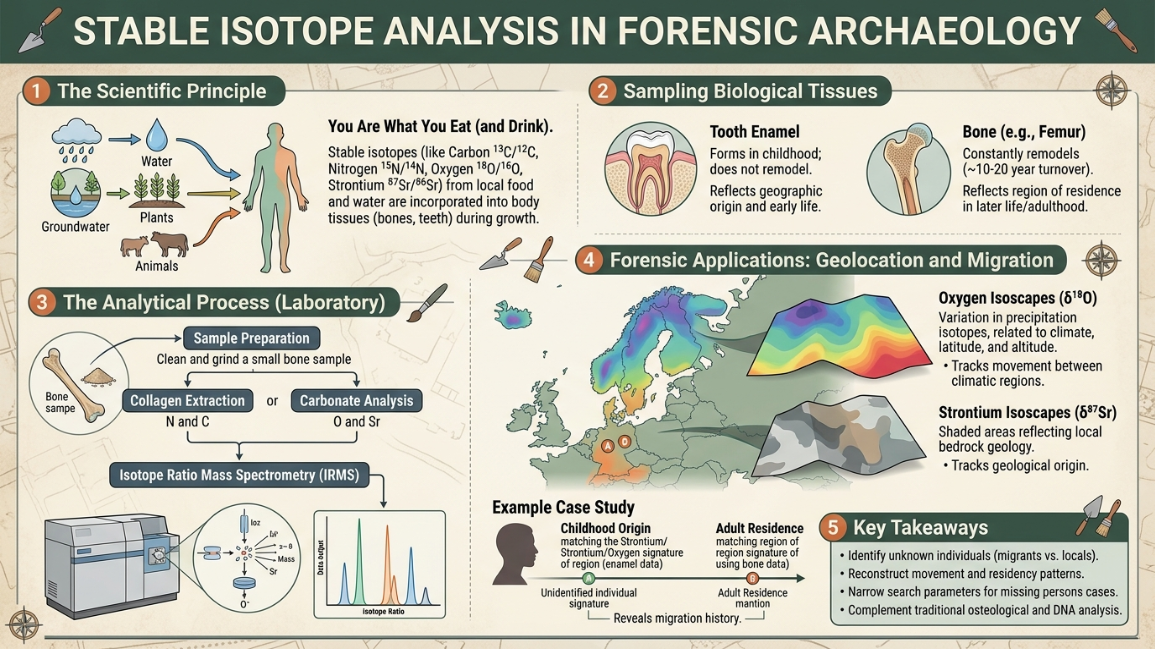
Stable Isotope Analysis in Forensic Archaeology: 7 Clues Hidden in Ancient Bones
Introduction
Every human skeleton preserves a chemical record of life. Long after soft tissue has disappeared and written history has been lost, microscopic elements stored inside bones and teeth continue to reveal where an individual lived, what they ate, how they moved across landscapes, and even whether they experienced periods of starvation.
This scientific approach is known as stable isotope analysis in forensic archaeology, and it has become one of the most valuable tools available for investigating historical cold cases, unidentified human remains, and archaeological discoveries.
Unlike DNA, which identifies biological relationships, isotope analysis reconstructs a person’s environment and lifestyle. Every meal, every drink of water, and every change in location leaves a measurable chemical signature that researchers can detect centuries later.
Today, forensic archaeologists use stable isotope analysis alongside genetics, osteology, and radiocarbon dating to answer questions that traditional archaeology alone could never resolve.
Table of Contents
- What Is Stable Isotope Analysis?
- Why Bones Preserve Chemical Evidence
-
- Oxygen Isotopes Reveal Childhood Origins
-
- Strontium Isotopes Track Migration
-
- Carbon Isotopes Reconstruct Ancient Diets
-
- Nitrogen Isotopes Reveal Social Status and Nutrition
-
- Sulfur Isotopes Identify Coastal and Inland Populations
-
- Isotope Mapping Solves Historical Cold Cases
-
- Combining Isotopes with DNA Creates Stronger Evidence
- Conclusion
- Key Takeaways
- Frequently Asked Questions
- Further Reading & Sources
What Is Stable Isotope Analysis?
Stable isotope analysis in forensic archaeology examines naturally occurring chemical elements preserved within human bones and teeth.
These elements originate from:
- Drinking water
- Local geology
- Food sources
- Climate
- Environmental conditions
As bones develop and remodel throughout life, they permanently record these chemical signatures.
Scientists compare isotope ratios with regional reference maps to determine where an individual likely lived and whether they migrated during their lifetime.
Why Bones Preserve Chemical Evidence
Human bones are constantly rebuilt during life.
Minerals from food and water become incorporated into skeletal tissue, creating a long-term chemical archive.
Teeth preserve childhood isotope signatures because enamel forms early and does not remodel.
Bones, however, continually renew themselves, reflecting the final years of an individual’s life.
By comparing teeth and bones, investigators can determine whether someone moved from one region to another.
1. Oxygen Isotopes Reveal Childhood Origins
One of the most important applications of stable isotope analysis in forensic archaeology involves oxygen isotopes.
The oxygen isotope composition of drinking water varies according to:
- Rainfall
- Altitude
- Latitude
- Temperature
As children grow, tooth enamel records these regional water signatures.
Centuries later, scientists can compare those values with modern and archaeological reference databases to estimate where an individual spent childhood.
2. Strontium Isotopes Track Migration
Strontium originates from local bedrock.
Different geological formations produce unique isotope ratios.
Plants absorb strontium from soil.
Animals eat the plants.
Humans consume both.
The result is a geological fingerprint preserved inside bones and teeth.
Researchers frequently use strontium isotope analysis to determine whether ancient individuals were local residents or migrants from distant regions.
3. Carbon Isotopes Reconstruct Ancient Diets
Carbon isotope analysis reveals the types of plants people consumed.
Scientists distinguish between:
- C3 plants such as wheat, barley, and rice.
- C4 plants such as millet and maize.
Carbon values also indicate whether marine foods contributed significantly to the diet.
This information helps reconstruct ancient agriculture, trade, and food availability.
4. Nitrogen Isotopes Reveal Social Status and Nutrition
Nitrogen isotope values generally increase higher in the food chain.
Individuals consuming larger amounts of meat or seafood often display higher nitrogen levels.
Researchers use this evidence to investigate:
- Social inequality
- Elite burials
- Childhood malnutrition
- Famine
- Weaning practices
Combined with skeletal evidence, nitrogen isotopes provide valuable insight into ancient health.
5. Sulfur Isotopes Identify Coastal and Inland Populations
Sulfur isotope analysis distinguishes between marine and terrestrial environments.
Individuals living near coastlines often display sulfur signatures different from inland populations.
This technique assists archaeologists when studying:
- Maritime communities
- Island settlements
- Fishing economies
- Coastal migration
It is especially valuable when other isotope systems produce ambiguous results.
6. Isotope Mapping Solves Historical Cold Cases
Modern forensic laboratories maintain isotope reference maps covering many regions of the world.
When unidentified remains are recovered, isotope values can narrow the search area.
Historical cold case investigations have used isotope analysis to:
- Identify unknown soldiers.
- Trace migration routes.
- Distinguish local residents from travelers.
- Support archaeological interpretations.
Instead of searching entire countries, investigators can often focus on much smaller geographic regions.
Related Posts: How Forensic Archaeology Identifies Ancient Human Remains
7. Combining Isotopes with DNA Creates Stronger Evidence
The greatest strength of stable isotope analysis in forensic archaeology appears when multiple scientific methods are combined.
DNA answers questions about biological identity.
Isotopes explain environmental history.
Radiocarbon dating establishes chronology.
Osteology estimates age, biological sex, and stature.
Together, these techniques provide a far more complete picture than any single method alone.
Conclusion
The development of stable isotope analysis in forensic archaeology has transformed the investigation of historical cold cases and ancient human remains.
Bones no longer represent silent archaeological discoveries.
Instead, they preserve chemical records that reveal childhood origins, migration patterns, diet, environmental exposure, and social history.
As laboratories continue improving isotope mapping and analytical precision, researchers will uncover even more information from remains once considered impossible to identify.
For forensic archaeology, chemistry has become one of history’s most powerful storytellers.
Key Takeaways
- Stable isotope analysis studies chemical signatures preserved in bones and teeth.
- Oxygen isotopes estimate childhood origin.
- Strontium isotopes identify migration.
- Carbon isotopes reconstruct diet.
- Nitrogen isotopes reveal nutrition and social status.
- Sulfur isotopes distinguish coastal and inland populations.
- Combining isotope analysis with DNA greatly strengthens historical investigations.
Frequently Asked Questions
What is stable isotope analysis in forensic archaeology?
Stable isotope analysis in forensic archaeology measures naturally occurring chemical elements preserved in bones and teeth to reconstruct an individual’s geographic origin, diet, and migration history.
Can isotope analysis identify a specific person?
No. Isotope analysis cannot identify an individual by itself, but it provides valuable information about where they lived and how they lived, complementing DNA and other forensic methods.
Why are teeth important for isotope analysis?
Tooth enamel forms during childhood and preserves chemical signatures from that period, allowing scientists to estimate where a person spent their early years.
Is stable isotope analysis used in modern forensic investigations?
Yes. It is used in both archaeological research and modern unidentified human remains investigations to narrow geographic origins and support identification efforts.
Further Reading & Sources
Official Resources
National Institute of Justice (NIJ)
https://nij.ojp.gov/
British Geological Survey
https://www.bgs.ac.uk/
Smithsonian Institution
https://www.si.edu/
National Park Service – Archaeology Program
https://www.nps.gov/archeology/
Academic References
Journal of Archaeological Science
https://www.sciencedirect.com/journal/journal-of-archaeological-science
Forensic Science International
https://www.sciencedirect.com/journal/forensic-science-international
International Journal of Osteoarchaeology
https://onlinelibrary.wiley.com/journal/10991212
Rapid Communications in Mass Spectrometry
https://analyticalsciencejournals.onlinelibrary.wiley.com/journal/10970231
Editorial Note
This article is based on peer-reviewed research in bioarchaeology, forensic anthropology, isotope geochemistry, and archaeological science. Stable isotope analysis is presented as one component of multidisciplinary forensic investigations and is most effective when interpreted alongside archaeological context, DNA evidence, and osteological analysis.