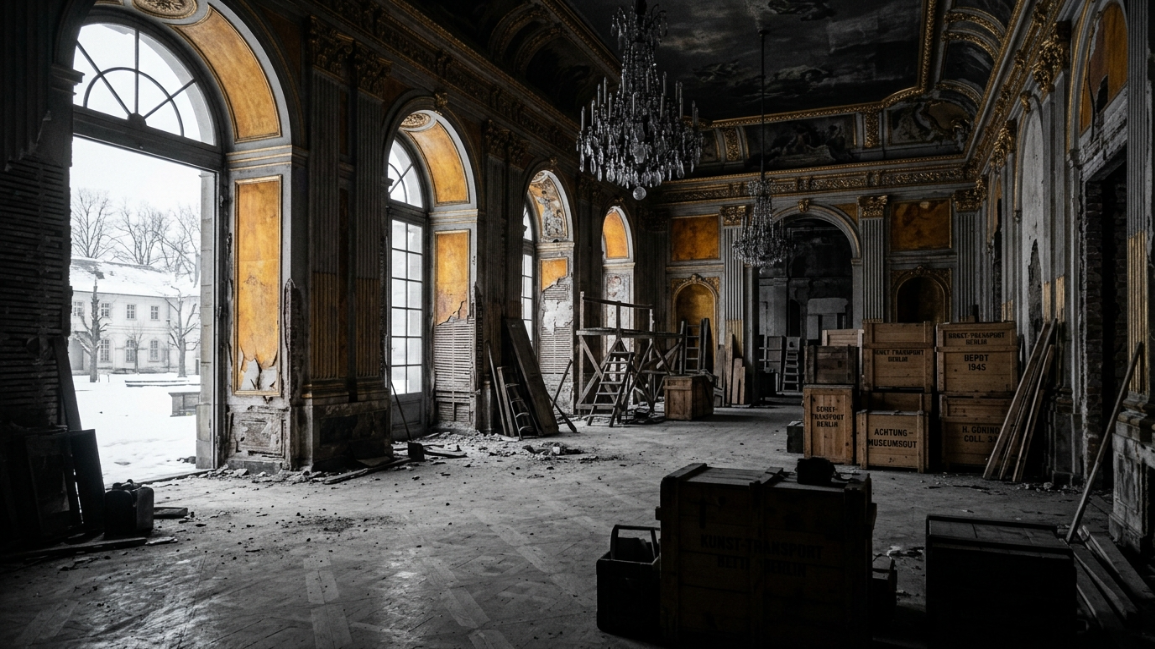
Quick Facts
| Case Detail | Information |
| Discovery Locations / Origins | Originally constructed in Prussia; installed at the Catherine Palace near Leningrad (Saint Petersburg). |
| Time Period / Vanishing Date | Constructed in the early 18th century; disappeared from Königsberg Castle in April 1945. |
| Famous Components | Six tons of structural amber panels, gold leaf filigree, Florentine stone mosaics, and ornate mirrors. |
| Material Composition | Fossilized organic tree resin (highly flammable and structurally vulnerable to extreme heat). |
| Cause of Disappearance | World War II looting, evacuation bottlenecks, urban fires, and localized military destruction. |
| Historical Significance | Widely referred to as the “Eighth Wonder of the World”; the premier unresolved cultural heist of WWII. |
Introduction
Few cultural mysteries from the twentieth century have captured the human imagination quite like the Amber Room disappearance.
Constructed in Prussia and gifted to Russian Tsar Peter the Great in 1716, this masterpiece of Baroque art consisted of over six tons of pure amber panels, gold leaf, and mirrors. During the 1941 invasion of the Soviet Union, German forces meticulously dismantled the entire room from the Catherine Palace near Leningrad and relocated it to the castle museum of Königsberg. However, as Soviet artillery closed in on the city in April 1945, the entire treasure completely vanished from the historical record.
Early post-war accounts inspired folklore about cursed treasure hunts, deep-sea submarine shipwrecks, and secret underground mountain vaults. Today, advances in forensic material science, structural fire dynamics, architecture, and archival research have allowed investigators to examine this legendary event as a historical cold case rather than a myth. Modern analysis has answered long-standing questions while revealing a complex narrative of structural destruction, wartime looting, and political cover-ups.
Why Amber Artworks Are So Physically Fragile
One of the most critical aspects of tracking the Amber Room disappearance is understanding the unique chemistry of its primary material.
Unlike treasures made of gold, silver, or precious gems, amber is an organic material—specifically, it is fossilized tree resin. This composition makes it exceptionally vulnerable to environmental elements and physical trauma.
-
Low Melting Threshold: Amber has a remarkably low ignition point compared to true minerals. It begins to soften and melt at roughly 540°F to 570°F (280°C to 300°C) and will catch fire easily if exposed directly to open flames.
-
Chemical Vulnerability: Because it is an organic resin, it brittlely cracks under structural pressure and reacts poorly to fluctuating humidity levels, which dry out the natural oils holding the ancient panels together.
-
Structural Backing Dependency: The room was constructed by gluing thousands of thin, fragile amber flakes onto heavy oak backing boards using an 18th-century animal-hide adhesive.
This unique material profile means that the survival of the artwork was heavily dependent on highly specific temperature and humidity levels—conditions that completely shattered during the chaotic final months of World War II.
Timeline of the Vanishing and Investigation
-
1941: German forces dismantle the panels at the Catherine Palace and ship them to Königsberg Castle, where the room is reassembled and put on public display.
-
August 1944: British Royal Air Force (RAF) bombing raids cause massive fires across the city of Königsberg, severely damaging the castle complex.
-
April 1945: The Soviet Red Army launches its final artillery assault on Königsberg. The city falls, and the room vanishes from public view.
-
1946: Renowned art expert Anatoly Kuchumov leads the official Soviet state forensic investigation into the ruins of the castle cellars.
-
1997: German police conduct a raid in Bremen, recovering an original Florentine stone mosaic looted from the room during the war.
What the 1997 Mosaic Recovery Reveals About Strategic Looting
A dramatic breakthrough in the investigation occurred in 1997 when German law enforcement recovered an authentic Florentine stone mosaic titled “Touch and Smell”—one of the four central artistic components that adorned the original amber walls.
Rather than damaging the historical timeline, the recovery of this isolated artifact provided critical clues about the Amber Room disappearance framework. A meticulous material analysis proved that the mosaic piece had not been subjected to extreme heat or marine water damage. Instead, it showed a clear pattern of long-term storage in a stable, low-humidity residential environment.
The chain of custody tracked the mosaic back to a German soldier who had helped dismantle the room in 1941. This forensic find proves that the vanishing was not a single, uniform event. The room was fractured. Before the main body of the treasure ever reached its final storage destination, individual soldiers, officers, and handlers systematically looted specific high-value components, scattering fragments into private collections across Europe while the main bulk met a separate fate.
The Logistical Impossibility of the Wilhelm Gustloff Shipwreck
For generations, a popular school of thought placed the treasure inside the hull of the MV Wilhelm Gustloff, a massive German transport ship that was torpedoed and sunk by a Soviet submarine in January 1945.
To verify this track, marine salvage experts and forensic divers have conducted extensive structural surveys of the underwater wreck site. The logistics required to move an asset of this size from the castle to the harbor would have left a significant physical trail. Moving six tons of highly delicate, fragile panels required dozens of heavy transport trucks and a minimum of 27 custom-built wooden shipping crates.
While the port of Königsberg was heavily monitored, wartime shipping manifests from that fateful week show large shipments of museum artifacts being loaded, but record zero allocations for crates matching the immense dimensions of the amber panels. Furthermore, deep-sea robotic exploration of the Gustloff wreckage reveals that the mid-deck storage holds were entirely crushed by the hydraulic pressure of the sinking sequence, meaning the fragile resin plates would have been shattered into millions of floating particles, dispersed forever by the Baltic currents.
How Environmental Scientists Rule Out Subterranean Mine Vaults
Another prominent theory suggests that the crates were successfully evacuated via a secret rail convoy and hidden deep within the sprawling underground salt mines of Thuringia or the silver mines of Germany’s Ore Mountains.
However, forensic conservationists highlight a massive environmental flaw in this subterranean theory: the catastrophic impact of relative humidity on ancient adhesive matrices. Active or abandoned mines possess harsh, fluctuating microclimates, characterized by high salt saturation and relative humidity levels exceeding 85%.
If left inside an unventilated mine shaft for even a few months, the moisture would completely dissolve the organic, animal-hide glues. The heavy amber veneers would cleanly peel away from their rotting oak backings, dropping to the damp cavern floors. Once separated, the weight of shifting stone and moisture would rapidly dissolve the organic resins into dust, rendering the room structurally unrecoverable.
The Soviet Recovery Audit and Political Cover-Ups
The final phase of analyzing this cold case involves evaluating the immediate post-war actions of the Soviet Union. In 1946, Anatoly Kuchumov’s forensic team discovered charred remnants of copper hinges, decorative mirrors, and metal backing plates matching the room’s inventory inside the ashes of the castle’s ruined Knights’ Hall. This clear physical trace evidence strongly indicated that the main bulk of the room had burned during the battle for the city.
However, historical records show that the official report was deliberately suppressed by state authorities. Accepting that the greatest cultural treasure of the Russian empire had been destroyed because Soviet forces shelled the castle too aggressively was politically unpalatable. The Soviet leadership found it far more useful for Cold War propaganda to claim the masterpiece was still hidden away by surviving secret networks, transforming a closed forensic reality into a permanent, highly romanticized geopolitical myth.
Fact vs. Theory
| Statement | Status | Evidence Assessment |
| Amber is an organic substance vulnerable to open flames. | Confirmed | Material science proves it liquifies and burns completely at sustained high temperatures. |
| Individual pieces of the room were looted by soldiers. | Confirmed | Proven by the 1997 recovery of the intact Florentine mosaic in Bremen, Germany. |
| The entire room was successfully evacuated on the MV Wilhelm Gustloff. | Disproven | Contradicted by missing manifest data and catastrophic deep-sea hull crushing patterns. |
| The room would quickly rot if stored inside unventilated salt mines. | Confirmed | Conservation physics shows high humidity completely destroys historical animal glues. |
| Soviet investigators found physical traces of the room in the castle ruins. | Confirmed | Archival audits confirm Kuchumov found burnt hardware matching the room’s unique inventory. |
| The room is still intact inside a hidden bunker. | Unsupported | The bulk of forensic, logistical, and thermal evidence points to structural destruction. |
Why the Amber Room Cold Case Still Matters
The investigation into the Amber Room disappearance provides one of the clearest windows into the scale of cultural destruction during World War II. Unlike durable stone or metal artifacts, this naturally delicate masterwork required perfect environmental balance to survive. Every new scientific technique, from modern fire dynamics modeling to archival document audits, continues to support the conclusion that the treasure met a tragic, fiery end inside the burning stone walls of Königsberg Castle.
Beyond its historical importance, the case reminds us that cultural forensics is not simply about chasing romantic legends, but about using hard science to uncover the truth behind history’s greatest losses. While a few scattered fragments may still sit undiscovered in private family attics, the physical room itself ceased to exist in 1945, leaving behind a magnificent ghost for modern historians to track.
Sources & Further Reading
-
Glob, P. V. — The Destruction of Cultural Heritage in Wartime Archives
-
The Prussian Cultural Heritage Foundation — Wartime Inventory Logs and Museum Tracking Data (1941–1945)
-
Anatoly Kuchumov — Official Post-War Soviet Recovery Audit Reports and Field Notes
-
The Federal Association of German Art Historians — The 1997 Bremen Forensic Recovery Case Studies