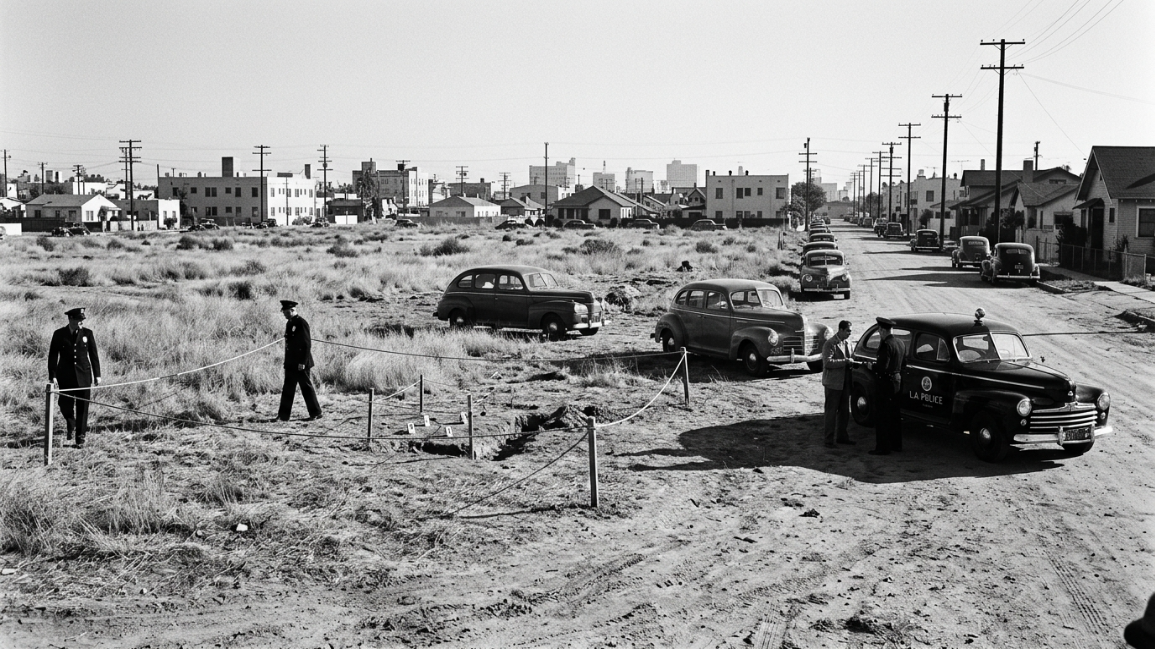
Quick Facts
| Case Detail | Information |
| Discovery Location | Vacant lot in Leimert Park, Los Angeles, California. |
| Time Period / Date | January 15, 1947 (Victim last seen January 9, 1947). |
| Famous Victim | Elizabeth Short, posthumously dubbed the “Black Dahlia”. |
| Condition of Remains | Cleanly bisected at the waist, entirely exsanguinated, and surgically washed. |
| Primary Cause of Death | Hemorrhaging from facial lacerations and shock from severe head trauma. |
| Historical Significance | One of the most heavily mythologized and famous unsolved homicides in American history. |
Introduction
Few criminal discoveries have transformed our understanding of mid-century homicides quite like the brutal slaying of Elizabeth Short. Recovered from a vacant field in the Leimert Park neighborhood of Los Angeles, the remarkably mutilated remains immediately shocked seasoned investigators and the public alike. The young woman’s body had been severed cleanly in half, completely drained of blood, and systematically scrubbed of external trace elements before being staged.
Early sensationalized newspaper headlines inspired decades of folklore about chaotic street transients, underworld mobs, and romanticized Hollywood predators. Today, advances in forensic pathology, modern profiling, and rigorous historical reviews have allowed researchers to evaluate this crime as a cold case rooted in physical evidence rather than media speculation.
Although the case has generated hundreds of dead ends and false confessions over the last eighty years, applying a rigorous Black Dahlia forensic analysis strips away the theatrical mythology. The physical mark left on the tissue and bones yields definitive proof that the perpetrator was an individual operating with clinical precision, advanced technical skills, and access to an industrial-grade environment.
Why the Hemicorporectomy Required Specialized Skills
One of the most remarkable and chilling aspects of the crime scene was the execution of the bisection itself.
Unlike standard unorganized homicides where a body is hacked or sawed apart out of panic, Elizabeth Short’s remains were divided using an anatomical technique known as a hemicorporectomy.
-
The Intervertebral Gap: The coroner’s autopsy performed by Dr. Frederick Newbarr documented that the body was transected through the lumbar spine precisely between the second and third lumbar vertebrae (L2 and L3).
-
Zero Bone Splintering: Navigating this specific boundary requires an advanced understanding of skeletal landmarks. The killer did not saw through the dense structural bone mass of the spinal column. Instead, they guided the blade cleanly through the narrow, soft intervertebral disc space, completely avoiding bone splintering or fracturing.
-
Clinical Instrumentation: The clean margins of the cut suggest the use of specialized professional tools, such as a post-mortem knife or a medical scalpel, rather than crude makeshift saws.
This level of anatomical efficiency heavily reinforces the initial suspicions held by the LAPD and the FBI that the killer possessed formal surgical, medical, or mortuary training.
Timeline of the Crime and Investigation
-
January 9, 1947: Elizabeth Short is last seen alive in the lobby of the Biltmore Hotel in downtown Los Angeles.
-
January 15, 1947: A local mother discovers the bisected, posed body in a vacant Leimert Park lot.
-
January 16, 1947: Dr. Frederick Newbarr performs the official autopsy, documenting total blood loss and head trauma.
-
January 24, 1947: The killer mails a gasoline-washed package to LA newspapers containing Short’s personal address book and documents.
-
1949–Present: Multiple medical professionals and high-profile suspects are evaluated through handwriting audits and circumstantial link matrices.
Total Post-Mortem Exsanguination and Site Laundering
A second critical anomaly analyzed during a modern Black Dahlia forensic analysis is the total absence of blood at the disposal site. Despite the extensive structural trauma inflicted upon the body, the vacant Norton Avenue lot contained zero bloodstain pooling or soil saturation.
This spatial reality confirms that the vacant lot was strictly a secondary dump site. The victim had been entirely exsanguinated—fully drained of her entire blood volume—in a separate, controlled indoor environment.
Achieving complete vascular drainage without leaving mass pooling requires placing the body inside a plumbed facility with drainage infrastructure, such as a professional operating theater, a morgue table, or a commercial embalming room. Furthermore, the body surface had been washed thoroughly and scrubbed clean with water by the killer. This intensive post-mortem laundering sequence was designed to completely eliminate any hair, fibers, or touch DNA before the remains were transported and staged in broad daylight.
What the Lack of Defensive Bruising Reveals
To understand the dynamic interaction between the victim and the offender, forensic anthropologists analyze the presence of defensive contusions along the hands, wrists, and forearms. In a typical high-velocity assault, a conscious victim instinctively raises their limbs to shield vital areas, leaving deep tissue bruising behind.
The official autopsy report outlines a striking absence of any antemortem trauma or struggle marks on Elizabeth Short’s hands or arms. While localized ligature marks were noted around her wrists, ankles, and neck, these impressions showed minimal cellular inflammation or ecchymosis. This means the restraints were applied either immediately before or shortly after her heart stopped beating.
The complete lack of classic defensive wounds indicates that the victim was entirely incapacitated early in the sequence. She was likely rendered unconscious before any of the structural trauma occurred, either through a severe concussive blow to the scalp—as confirmed by the bleeding found in her subarachnoid space—or through chemical sedation, preventing her from mounting any physical resistance.
The Symmetrical Mechanics of the Facial Lacerations
The most visually striking behavioral signature left on the body was a pair of deep linear incisions slicing outward from the corners of the mouth toward the ears, a disfigurement known as a “Glasgow Smile”.
When path-analysts review the microscopic margins of these facial cuts, the physical traits provide vital clues. The lacerations measured exactly three inches on the right side and approximately two and a half inches on the left side, displaying remarkably sharp, un-ragged margins.
This geometric precision indicates that the cuts were executed while the facial tissue was taut and completely immobile. Had the victim been actively struggling or moving her facial muscles, the blade trajectories would be erratic, showing jagged edges and variable depths. The precision of these cuts points to a controlled, conscious effort to distort the victim’s natural facial appearance while she was entirely immobilized under the killer’s control.
Fact vs. Theory
| Statement | Status | Evidence Assessment |
| The bisection was executed with advanced anatomical knowledge. | Confirmed | The cut perfectly targeted the L2-L3 intervertebral disc space without splintering bone. |
| Elizabeth Short was killed at the vacant lot where she was found. | Disproven | Total exsanguination and washing confirm the field was a secondary dump site. |
| The cause of death was blood loss and severe head trauma. | Confirmed | The coroner ruled death occurred via hemorrhaging from facial cuts and brain concussion. |
| The killer contacted the media and returned her personal items. | Confirmed | A gasoline-cleaned package with Short’s address book was sent directly to newspapers. |
| The murder was a random, spontaneous street assault. | Unsupported | The multi-day transit window and clinical processing prove a highly organized sequence. |
Why the Black Dahlia Cold Case Still Matters
A modern Black Dahlia forensic analysis provides one of the clearest windows into the power of physical evidence over sensationalized media narratives. Unlike temporary rumors, the physical marks left on the tissue and bones stand as a permanent behavioral blueprint. Every new investigative review continues to strip away the Hollywood folklore, pointing directly to a highly disciplined predator who used clinical capabilities and secure, industrial environments to execute his crime. By studying the real science of wound morphology, anatomical bisections, and vascular logistics, modern investigators ensure that this iconic tragedy is treated not as a theatrical legend, but as an authentic forensic case study that continues to challenge the limits of criminal pathology.
A modern Black Dahlia forensic analysis provides one of the clearest windows into the power of physical evidence over sensationalized media narratives. Unlike temporary rumors, the physical marks left on the tissue and bones stand as a permanent behavioral blueprint. Every new investigative review continues to strip away the Hollywood folklore, pointing directly to a highly disciplined predator who used clinical capabilities and secure, industrial environments to execute his crime. By studying the real science of wound morphology, anatomical bisections, and vascular logistics, modern investigators ensure that this iconic tragedy is treated not as a theatrical legend, but as an authentic forensic case study that continues to challenge the limits of criminal pathology.
Sources & Further Reading
- The Federal Bureau of Investigation — The Black Dahlia (Elizabeth Short) Freedom of Information Act (FOIA) Freedom Files
- Dr. Frederick Newbarr — Official Los Angeles County Coroner Autopsy Report: Case No. 31653 (January 16, 1947)
- The Los Angeles Police Department — Historical Homicide Division Case Records and Suspect Audits (1947–1951)